High-Impact Industrial Corrosion Morphologies
3D cross-sectional inspection models depicting physical damage mechanisms and corresponding NDT sensor arrays.
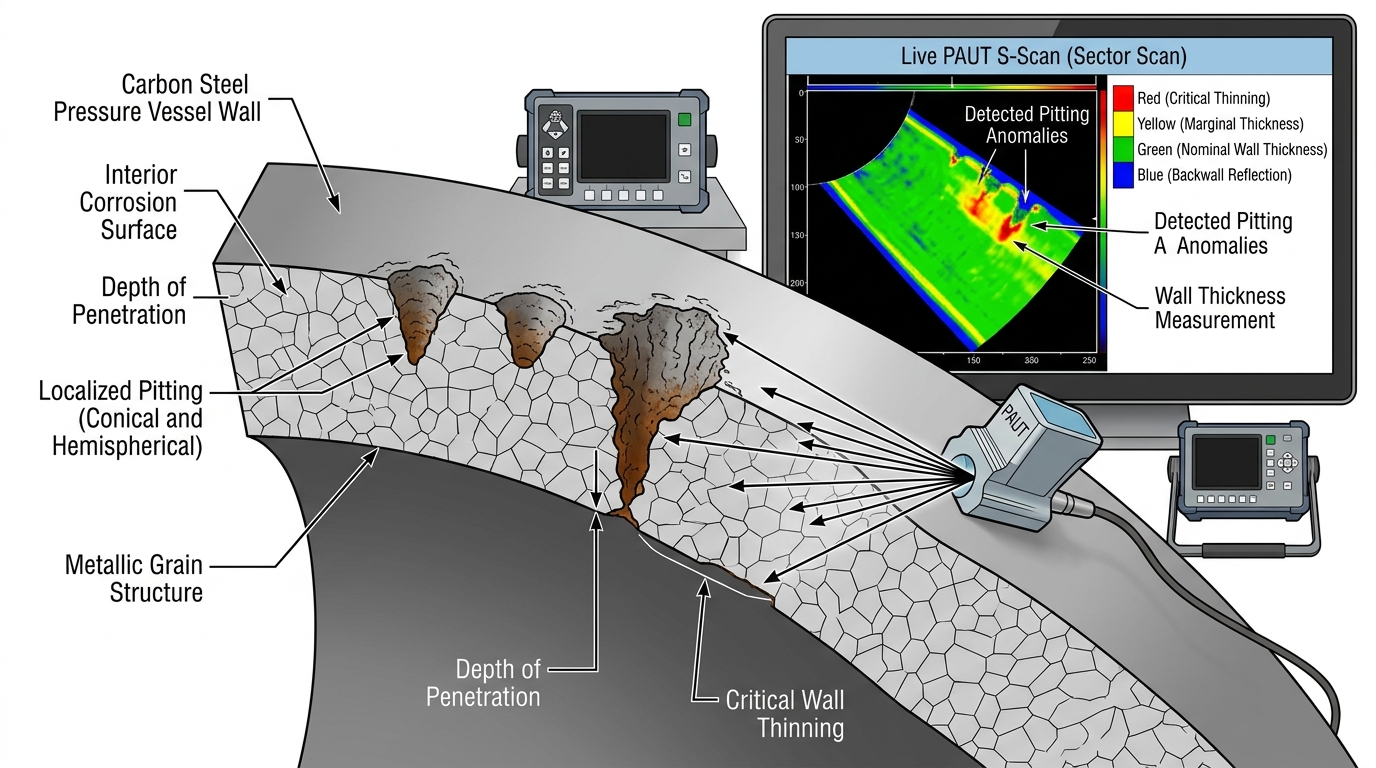
Macro cutaway of localized pitting cavities with PAUT ultrasound S-Scan depth profiling.
Pitting Corrosion
Extremely localized accelerated metal loss where the depth of penetration significantly exceeds the surface diameter, penetrating walls with negligible overall weight loss.
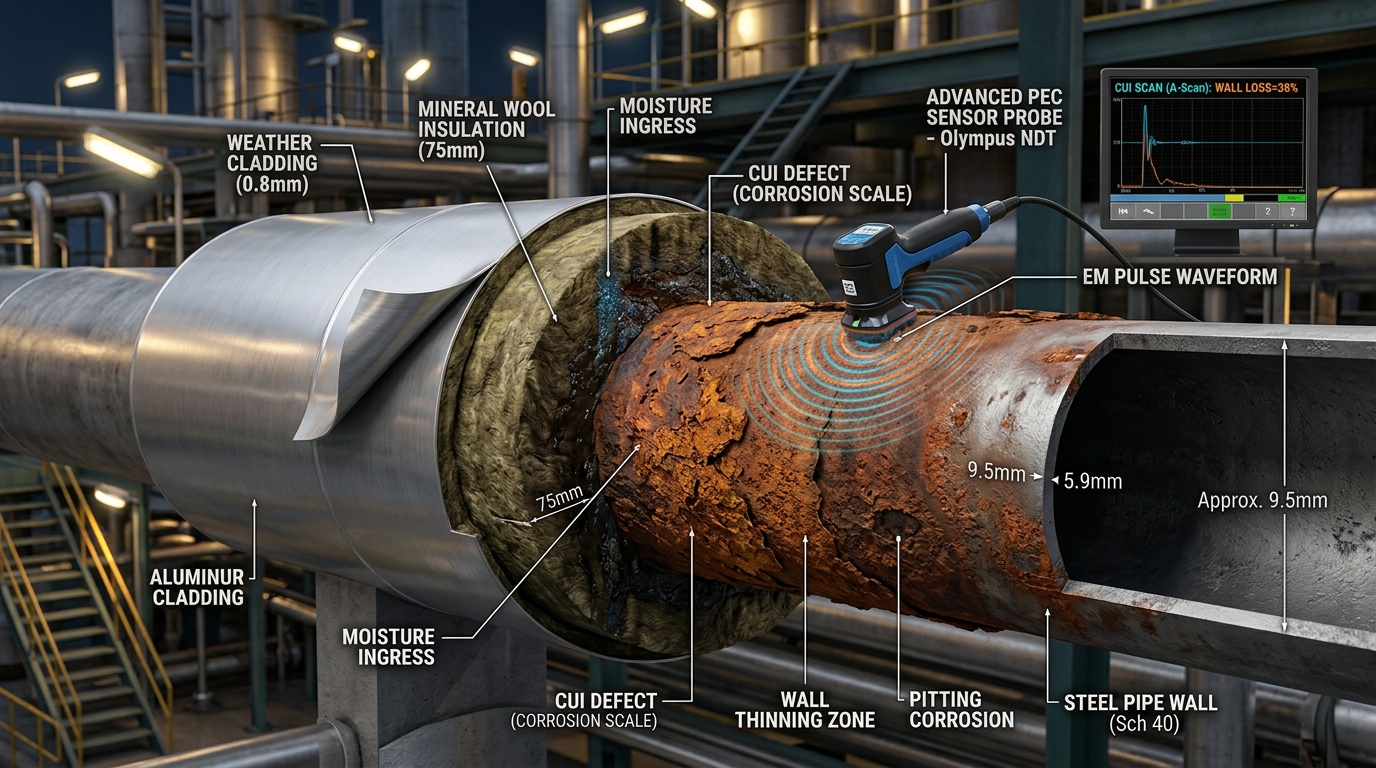
Cutaway of mineral wool insulation on a refinery pipe revealing CUI wall thinning and PEC probe scanning.
Corrosion Under Insulation (CUI)
Severe external localized corrosion attacking carbon and low-alloy steels beneath thermal insulation and fireproofing jacketing, caused by trapped moisture and atmospheric contaminants.
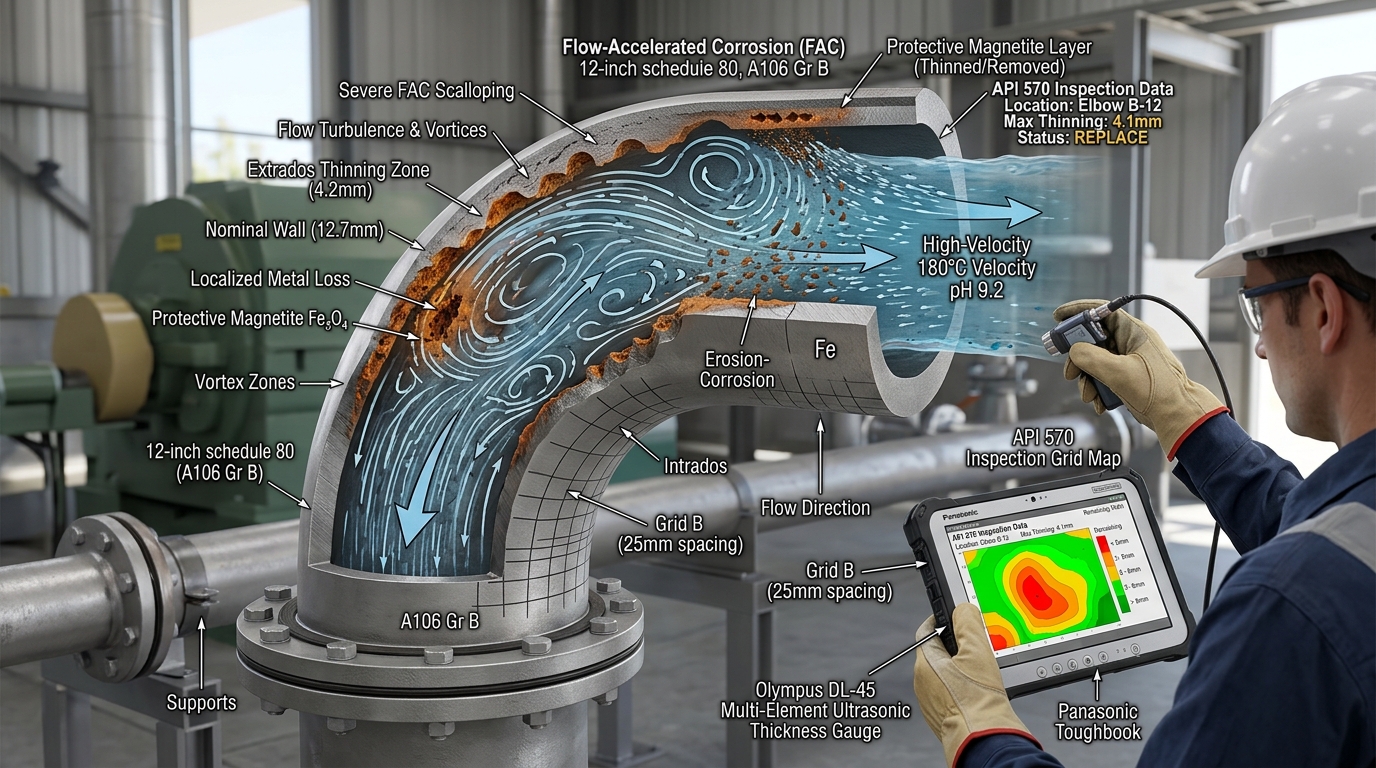
Detailed cutaway of a 90° pipe elbow showing turbulent fluid eddies, extrados metal loss, and API 570 ultrasonic grid mapping.
Flow-Accelerated Corrosion (FAC)
Rapid dissolution of protective iron oxide (magnetite Fe3O4) scale on carbon steel piping caused by high-velocity turbulent single-phase or two-phase flowing water or wet steam.
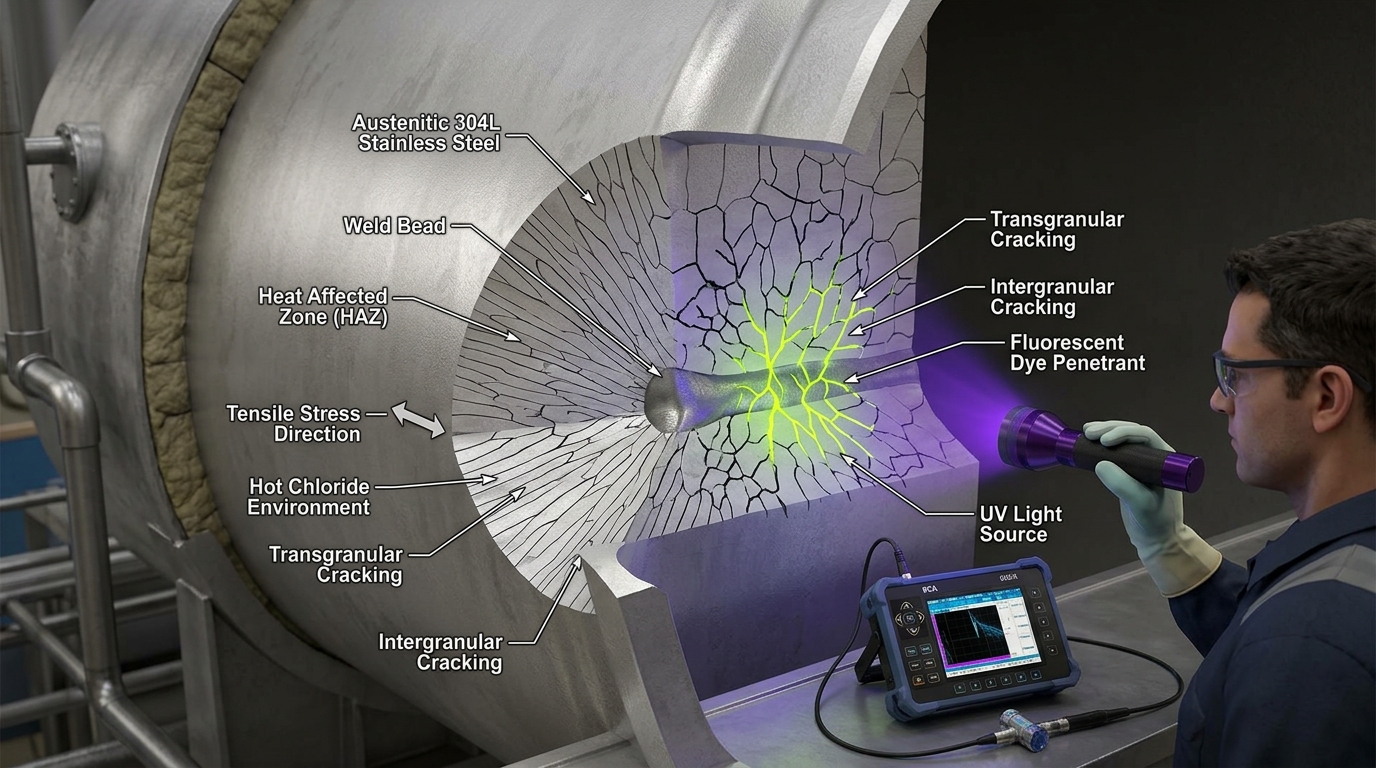
Cutaway of a 304L stainless steel pressure vessel weld with branched micro-fissures illuminated by UV fluorescent penetrant.
Stress Corrosion Cracking (SCC / CSCC)
Catastrophic brittle cracking of normally ductile alloys caused by the simultaneous combination of sustained tensile stress and a specific corrosive chemical environment.
The 10 Primary Types of Industrial Corrosion
Uniform (General) Corrosion
Even, consistent thinning across an entire metallic surface caused by uniform chemical or electrochemical reaction with surrounding atmospheric or process media.
Even wall thickness reduction with rough, oxidized surface layer and absence of localized deep pits.
Corrosion allowance addition (typically 3mm or 6mm), protective industrial coatings, cathodic protection (CP), sacrificial zinc/aluminum anodes.
Pitting Corrosion
Extremely localized accelerated metal loss where the depth of penetration significantly exceeds the surface diameter, penetrating walls with negligible overall weight loss.
Conical, hemispherical, and subsurface undercut cavities hidden beneath thin surface oxide blisters.
Use of high-PREN alloys with >2.5% Molybdenum (316L, 2205 Duplex), biocide treatment in stagnant waters, eliminating stagnant deadlegs.
Crevice Corrosion
Localized corrosion occurring in narrow stagnant gaps, lap joints, and shielded contact zones where oxygen depletion creates an aggressive, acidic micro-cell environment.
Aggressive gouging, localized pitting, and wall thinning confined strictly within the shielded contact area.
Continuous seal welding instead of bolted lap joints, selecting non-absorbent elastomeric gaskets, applying PTFE paste to flange faces.
Galvanic (Bimetallic) Corrosion
Accelerated electrochemical attack occurring when two metals with differing electrode potentials are electrically coupled in the presence of a common conductive electrolyte.
Severe localized degradation on the less noble (anode) metal immediately adjacent to the bimetallic interface.
Dielectric insulating bolt sleeves & flange gasket kits, monolithic isolation joints, sacrificial zinc/aluminum anodes.
Corrosion Under Insulation (CUI)
Severe external localized corrosion attacking carbon and low-alloy steels beneath thermal insulation and fireproofing jacketing, caused by trapped moisture and atmospheric contaminants.
Heavy, flaky reddish-brown iron oxide scale covering extensive scalloped metal loss and localized deep pits.
High-solids immersion-grade epoxy novolac coatings, aluminum foil wrap barriers, hydrophobic aerogel insulation, sealed weather cladding overlaps.
Flow-Accelerated Corrosion (FAC)
Rapid dissolution of protective iron oxide (magnetite Fe3O4) scale on carbon steel piping caused by high-velocity turbulent single-phase or two-phase flowing water or wet steam.
Scalloped, orange-peel, or horseshoe-shaped dimples oriented in the fluid flow direction, primarily on elbow extrados.
Material upgrade to low-alloy Cr-Mo steels (1.25% Cr or 2.25% Cr), water chemistry optimization (pH > 9.2 with oxygen scavenging), swept elbow radius increase.
Microbiologically Influenced Corrosion (MIC)
Deterioration of metals resulting from the metabolic activities of bacteria and microorganisms, notably Sulfate-Reducing Bacteria (SRB) and Acid-Producing Bacteria (APB).
Hemispherical, stepped crater-like pits located beneath dense black or brown biological nodules (tubercles).
Continuous biocide treatment (glutaraldehyde, sodium hypochlorite), mechanical pigging and scraper runs, eliminating deadlegs and stagnant low points.
Stress Corrosion Cracking (SCC / CSCC)
Catastrophic brittle cracking of normally ductile alloys caused by the simultaneous combination of sustained tensile stress and a specific corrosive chemical environment.
Branched, spiderweb-like transgranular or intergranular micro-fissures propagating perpendicular to tensile stress.
Post-Weld Heat Treatment (PWHT) to eliminate residual stress, upgrading to Duplex (2205) or Super Duplex (2507) alloys, soda ash neutralization for Polythionic Acid.
Intergranular Corrosion (IGC) & Sensitization
Preferential attack along the microscopic grain boundaries of stainless steels caused by the precipitation of chromium carbides (Cr23C6), depleting corrosion-resistant chromium in adjacent zones.
Loss of metallic cohesion along grain boundaries leading to crumbly, sugary metal disintegration without macroscopic thinning.
Use low-carbon stainless grades (304L, 316L with C ≤ 0.03%), chemically stabilized alloys (321 with Titanium, 347 with Niobium), full solution annealing at 1050°C.
High-Temperature Hydrogen Attack (HTHA)
Sub-surface structural degradation occurring when carbon and low-alloy steels are exposed to hydrogen at elevated temperature and high partial pressure, generating internal methane pockets.
Sub-surface microscopic methane voids, intergranular micro-fissures, and surface decarburization with zero visible wall loss.
Strict adherence to API RP 941 Nelson Curves, replacing legacy C-0.5Mo with Cr-Mo alloys (1.25Cr-0.5Mo, 2.25Cr-1Mo, or 2.25Cr-1Mo-0.25V).
Corrosion Damage Mechanism Diagnostic Matrix
Quick lookup mapping physical plant symptoms directly to suspected damage mechanisms and optimal inspection tools.
| Observed Physical Symptom | Suspected Mechanism | Standard Code | Best NDT Sizing Physics | Severity | Action |
|---|---|---|---|---|---|
| Localized thinning on insulated piping under aluminum cladding | Corrosion Under Insulation (CUI) | API 571 §3.22 | Pulsed Eddy Current (PEC) & Long-Range GWT | HIGH | Find Gear |
| Scalloped horseshoe thinning on 90° boiler feed elbow | Flow-Accelerated Corrosion (FAC) | API 571 §3.27 | Automated Ultrasonic 0° Grid (AUT / PAUT) | CRITICAL | Find Gear |
| Deep localized pinholes in stainless steel heat exchanger tubes | Pitting & Crevice Corrosion | API 571 §3.44 | IRIS (Internal Rotary Ultrasound) & Eddy Current (ECT) | HIGH | Find Gear |
| Fine spiderweb cracks glowing on stainless weld under UV light | Stress Corrosion Cracking (Chloride SCC) | API 571 §3.17 | Fluorescent Penetrant (PT) & Eddy Current Array (ECA) | CRITICAL | Find Gear |
| Blistering & internal voiding in hydrotreater pressure vessel | High-Temperature Hydrogen Attack (HTHA) | API 571 §3.36 | Advanced Ultrasonic Backscatter (AUBT) & TFM/FMC | CRITICAL | Find Gear |
| Rapid underside floor plate thinning in crude storage tank | Soil-Side Underside Pitting & MIC | API 653 / API 571 §3.45 | Magnetic Flux Leakage (MFL) Floor Crawler | HIGH | Find Gear |
| Severe accelerated thinning on steel pipe bolted to bronze valve | Galvanic (Bimetallic) Corrosion | API 571 §3.31 | Dual-Element UT Thickness Scan & Potential Survey | MEDIUM | Find Gear |
| Crumbly intergranular cracking in HAZ of non-stabilized 304 weld | Intergranular Corrosion (Sensitization) | API 571 §3.38 | Field Metallographic Replica & Angle-Beam Shear Wave | HIGH | Find Gear |
API 510, 570 & 653 Corrosion Rate & Remaining Life Formulas
Mathematical formulas utilized by inspection software and Level II/III inspectors to calculate component fitness-for-service.
Corrosion Rate (CR)
Calculates annualized metal loss (mm/yr or mils/yr) between initial baseline wall thickness and current ultrasonic inspection readings.
Remaining Useful Life (RUL)
Determines the number of operating years remaining before the metal reaches the minimum allowable code design thickness (t_min).
Min Thickness (t_min)
Pressure vessel cylindrical shell minimum thickness required to resist internal operating pressure without tensile yield failure.
Screen Your Plant for Critical Corrosion Now
Rent calibrated Pulsed Eddy Current (PEC) scanners, hire ASNT Level III corrosion engineers, or post a turnkey CUI inspection RFP with 0% platform markup.