API RP 571 • ASME Sec VIII Div 2 • API 579-1 / ASME FFS-1

Mechanical Degradation & Fatigue Morphology Atlas

Exhaustive engineering atlas detailing high-cycle & low-cycle fatigue, thermal shock crazing, vibration-induced small-bore piping failures, high-temperature creep cavitation, cavitation erosion, and hydraulic shock. Includes NDT detection sensitivity matrix, Paris Law crack growth kinetics, and Larson-Miller creep life models.

Failure Modes10 Mechanisms
Governing CodesAPI 571 / 579
NDT Comparison9 Methods
Kinetics ModelsParis & LMP

Visual Morphology Showcase • High-Magnification NDT Reference

Micro-structural metallography, fluorescent indications, and ultrasonic flaw detector signatures for primary mechanical degradation modes.
4 High-Fidelity Profiles
Thermal Fatigue & Shock Crazing
API 571 §4.2.9

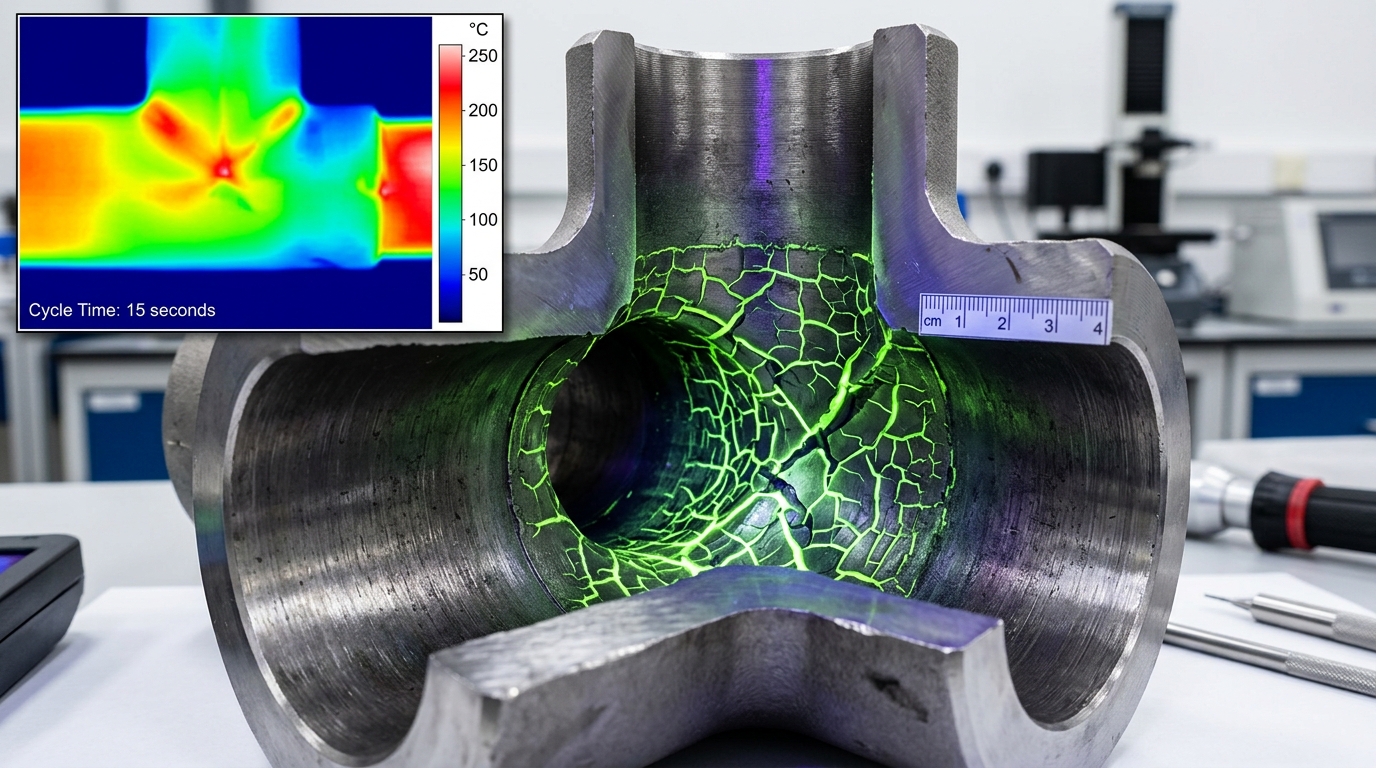
Thermal Fatigue & Shock Crazing

Characterized by an interlocking multi-directional network of surface fissures commonly termed "alligator crazing" or "elephant skin" cracking. Fissures initiate on the process-wetted inner diameter and propagate perpendicularly into the base metal, often filled with oxide scale.
View Inspection Sizing
Vibration-Induced Small-Bore Piping Fatigue
API 571 §4.2.17

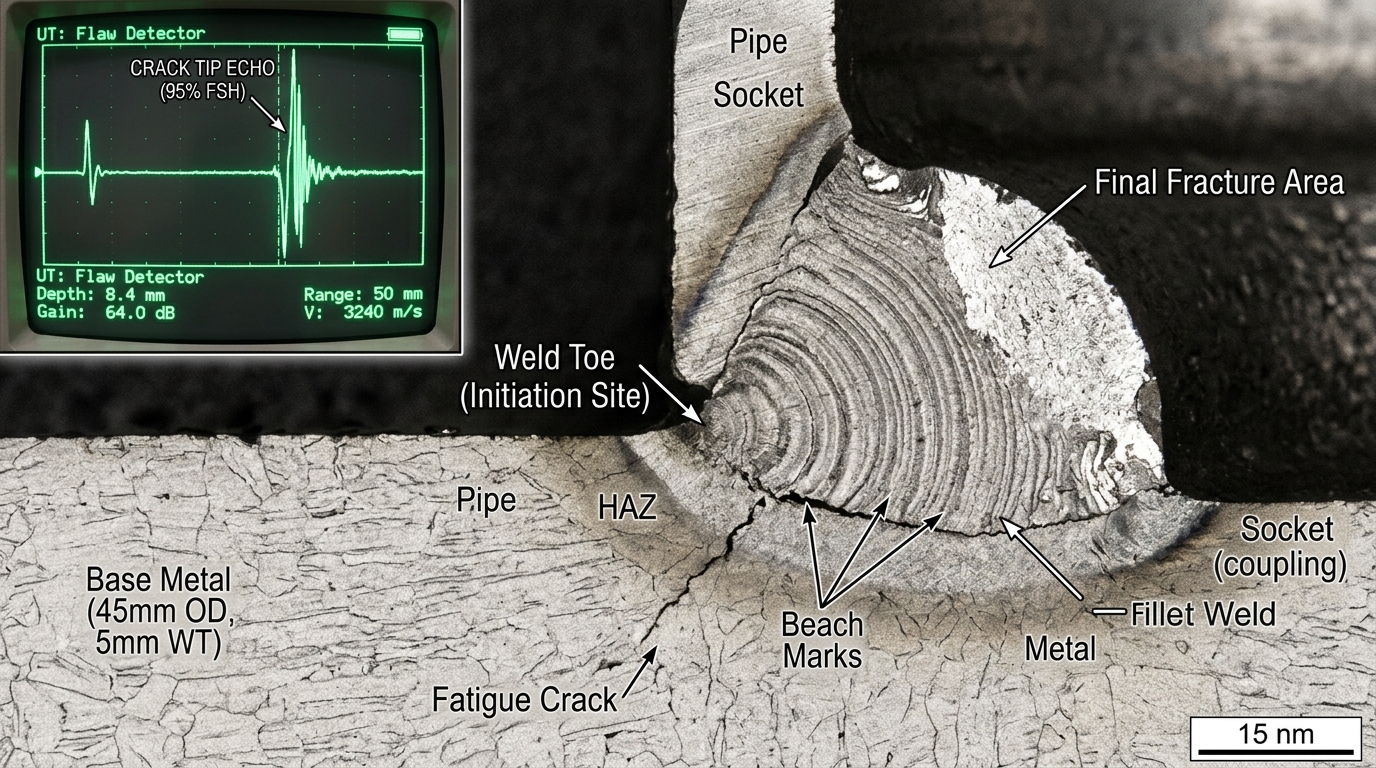
Vibration-Induced Small-Bore Piping Fatigue

Planar fatigue crack initiating at the fillet weld toe or root notch of socket welds, weldolets, or sockolets. Fracture surfaces reveal distinctive concentric beach marks and micro-striations radiating from the stress concentration apex.
View Inspection Sizing
High-Temperature Creep & Stress Rupture
API 571 §4.2.8

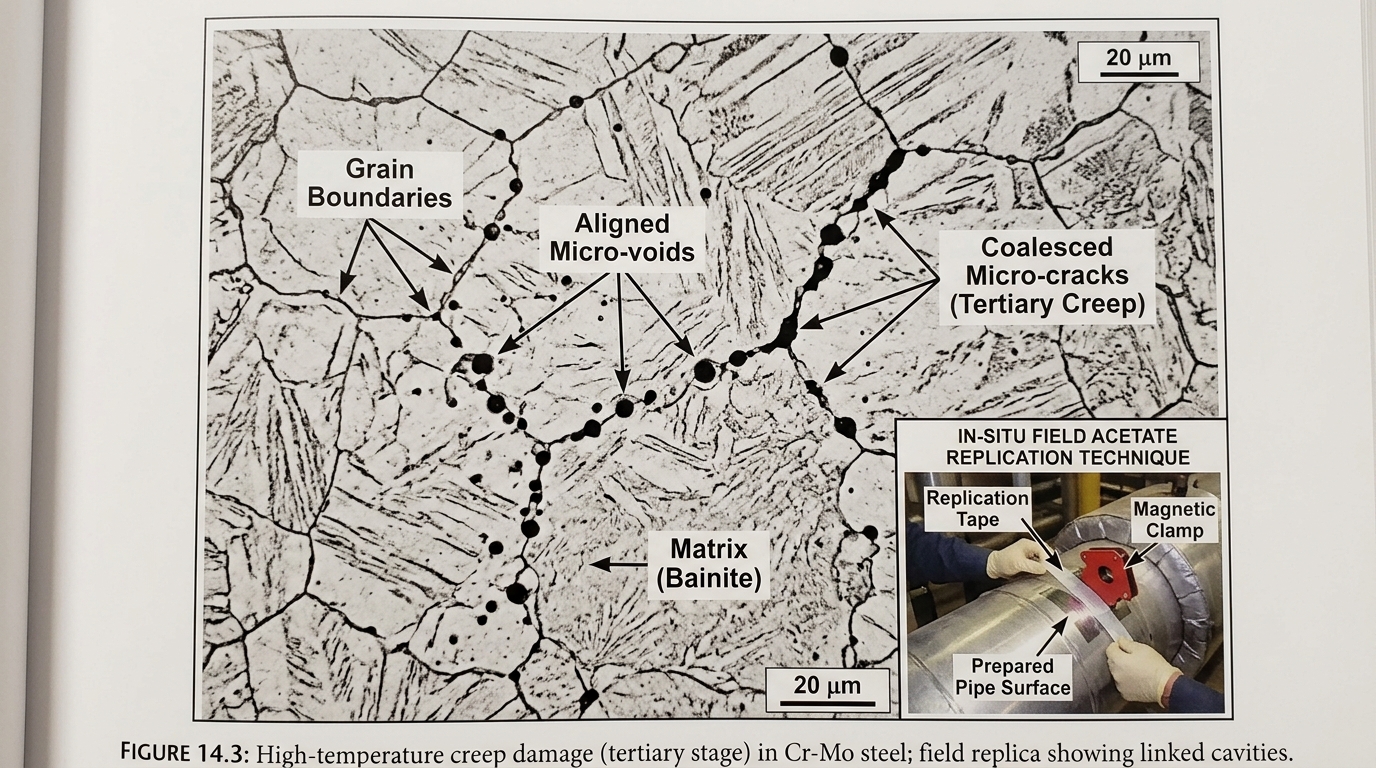
High-Temperature Creep & Stress Rupture

Progresses through 3 distinct metallurgical stages: Primary (strain hardening), Secondary (steady-state cavitation initiation), and Tertiary (micro-void coalescing into oriented intergranular micro-cracks and macro-fissures along prior austenite grain boundaries).
View Inspection Sizing
Cavitation Erosion & Liquid Droplet Impingement
API 571 §4.2.10

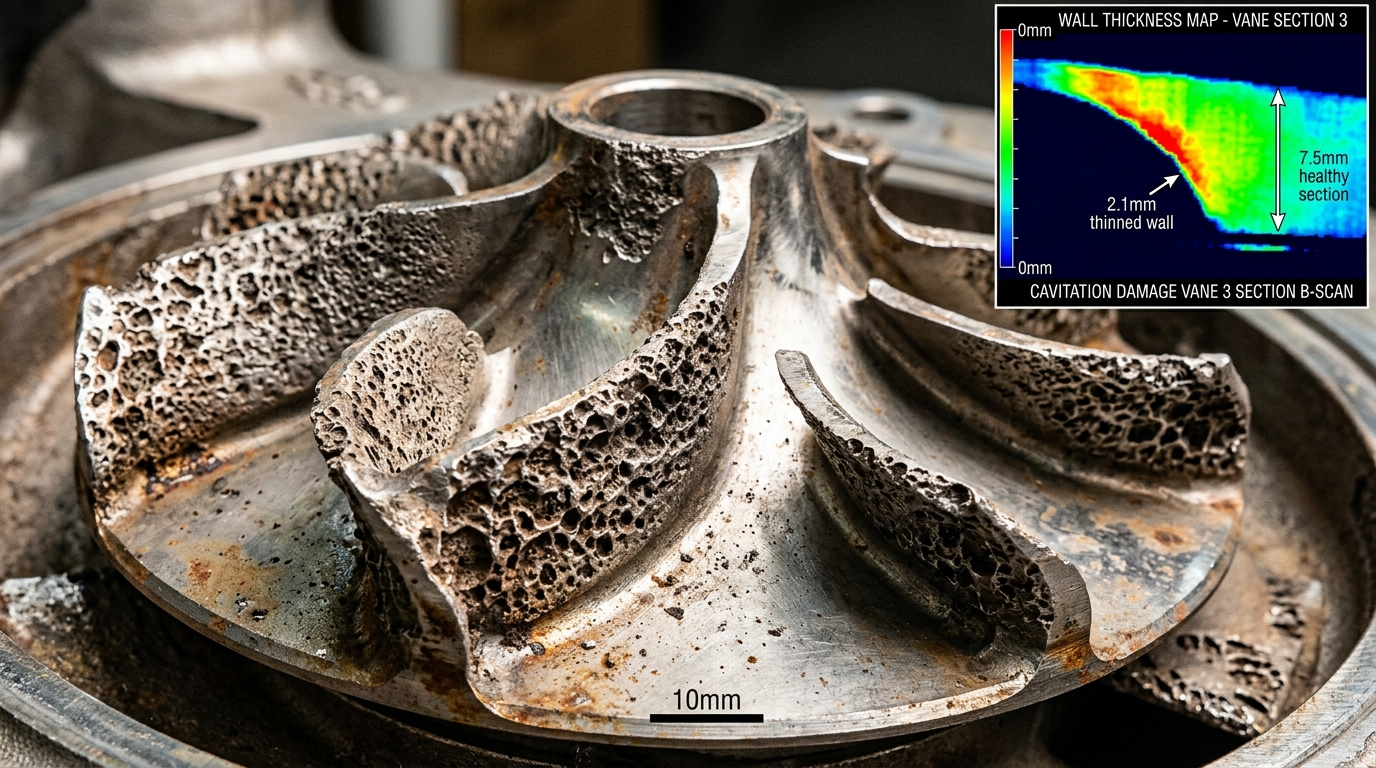
Cavitation Erosion & Liquid Droplet Impingement

Distinctive deeply pitted, sponge-like, or honeycombed surface texture with jagged, sharp-edged craters. Void of corrosion product; metal surfaces appear bright, clean, and mechanically gouged.

View Inspection Sizing
API 571 §4.2.9CRITICAL RISK

Thermal Fatigue & Shock Crazing

ASME Sec VIII Div 2 §5.5.3

Cracking induced by cyclic thermal stresses resulting from rapid temperature fluctuations or steep non-uniform thermal gradients across piping and vessel walls.

Primary NDT Techniques:
Fluorescent Penetrant Testing (PT)Angle Beam Phased Array UT (PAUT)Time of Flight Diffraction (TOFD)
High-Risk Assets:Piping Mixing Tees & Confluences • Boiler Superheater Quench Attemperators • Coker Blowdown Lines • Exchanger Tube-to-Tubesheet Welds
Temp: Delta T > 50°C (90°F) cyclic swing
API 571 §4.2.17CRITICAL RISK

Vibration-Induced Small-Bore Piping Fatigue

ASME B31.3 Appendix X / API 570

High-cycle, low-amplitude dynamic stress fatigue cracking occurring predominantly at unsupported small-bore connections (SBCs) and cantilevers exposed to acoustic or mechanical vibrations.

Primary NDT Techniques:
High-Frequency Ultrasonic Testing (Shear Wave)Fluorescent Magnetic Particle (FMPI)Alternating Current Field Measurement (ACFM)
High-Risk Assets:Small-Bore Branch Connections (SBC ≤ 2") • Thermowells & Sample Points • Pressure Relief Valve (PSV) Inlet Stubs • Compressor Discharge Manifolds
Temp: Ambient to maximum design operating temperature
API 571 §4.2.16CRITICAL RISK

Mechanical / Cyclic Fatigue (HCF & LCF)

ASME Sec VIII Div 2 Part 5 (Design by Analysis)

Progressive structural degradation and crack propagation caused by repeated cyclic mechanical loading below the ultimate tensile strength of the material.

Primary NDT Techniques:
Phased Array Ultrasonic Testing (PAUT)Time of Flight Diffraction (TOFD)Fluorescent Magnetic Particle (FMPI)
High-Risk Assets:Pressure Vessel Nozzle Radii • Piston Rods & Compressor Shafts • Cyclic Reactor Shells (PSA/Coker) • Structural Crane Girders & Lifting Lugs
Temp: Sub-creep temperatures (below 370°C for carbon steel, below 425°C for stainless steel).
API 571 §4.2.8CRITICAL RISK

High-Temperature Creep & Stress Rupture

ASME Sec I / Sec VIII Div 1 & 2 / API 579 Part 10

Time-dependent irreversible plastic strain deformation occurring under sustained mechanical stress at elevated temperatures, culminating in intergranular grain boundary cavitation and catastrophic stress rupture.

Primary NDT Techniques:
In-Situ Metallographic Replication (Acetate Replica)Diametral Creep Gauging & Laser ProfilometryFull Matrix Capture / TFM Ultrasonic
High-Risk Assets:Main Steam Piping & Hot Reheat Lines • Fired Heater Radiant Tubes • Reformer Tubes & Outlet Headers • Boiler Superheater / Reheater Headers
Temp: Carbon steel > 370°C (700°F)
API 571 §4.2.10MAJOR RISK

Cavitation Erosion & Liquid Droplet Impingement

ASME B31.3 / API 570 §5.7

Localized mechanical pitting and material erosion caused by the rapid formation and violent collapse of vapor bubbles in high-velocity liquid streams where static pressure drops below fluid vapor pressure.

Primary NDT Techniques:
High-Resolution Digital Ultrasonic Thickness (UTT B-scan)Internal Borescope / Video Visual Inspection (VT)Phased Array UT Corrosion Mapping (0° PAUT)
High-Risk Assets:Centrifugal Pump Impellers & Volutes • Control Valve Plugs & Cages • Downstream of Orifice Plates • Heat Exchanger Return Bends & Condenser Tubes
Temp: Fluid boiling/vaporization envelope
API 571 §4.2.13MAJOR RISK

Fretting Fatigue & Oscillatory Micro-Wear

API 579-1 Part 9 / ASME Sec VIII

Accelerated fatigue cracking and abrasive wear occurring at the contact interface between two tightly clamped surfaces subjected to minute oscillatory relative slip (amplitude 5 to 100 μm).

Primary NDT Techniques:
Eddy Current Testing (ECT)Fluorescent Magnetic Particle (FMPI)Fluorescent Liquid Penetrant (PT)
High-Risk Assets:Heat Exchanger Tubes at Baffle Plates • Turbine Blade Root Fir-Tree Fastenings • Bolted Flange Stud Thread Contacts • Wire Ropes & Guy Cables
Temp: Ambient to 400°C
API 571 §4.2.7CRITICAL RISK

Brittle Fracture & Low-Temp Impact Cleavage

ASME Sec VIII Div 1 UCS-66 / API 579 Part 3

Catastrophic, rapid cleavage fracture through a metal matrix with virtually no preceding plastic deformation, triggered when operating below the Ductile-to-Brittle Transition Temperature (DBTT).

Primary NDT Techniques:
Time of Flight Diffraction (TOFD)Phased Array Ultrasonic (PAUT Volumetric)Wet Fluorescent Magnetic Particle (WFMT)
High-Risk Assets:Thick-Walled Pressure Vessels • LPG / Ammonia Storage Spheres • Cold Hydrotest Equipment • Chilling Auto-Refrigeration Systems
Temp: Temperatures below the material Charpy impact transition curve
API 571 §4.2.14MAJOR RISK

Particle Erosion & Slurry Abrasion

ASME B31.3 / API 570 §5.7

Mechanical removal of protective surface oxide films and base metal through continuous impingement of solid particulate matter (sand, catalyst, fly ash) suspended in high-velocity liquid or gas carriers.

Primary NDT Techniques:
Pulsed Eddy Current (PEC Through-Insulation Screening)Continuous Ultrasonic Thickness Gauging (UTT Grid)Profile Radiography (PRT)
High-Risk Assets:FCCU Catalyst Cyclones & Slide Valves • Slurry Pipeline Elbows & Chokes • Coal Pulverizer Burner Piping • Produced Sand Choke Manifolds
Temp: Ambient to 750°C
API 571 §4.2.8 / ASME PCC-1MAJOR RISK

Flange Stud Bolt Stress Relaxation & Galling

ASME Section VIII Div 1 Appendix 2 / ASME PCC-1 Guidelines

Gradual loss of initial bolt pre-load clamping stress under sustained elevated temperature creep relaxation, accompanied by severe adhesive thread galling during thermal cycling.

Primary NDT Techniques:
Ultrasonic Bolt Tension Measurement (Delta Time-of-Flight)Wet Fluorescent Magnetic Particle (WFMT on Threads)Micrometer Dial Gauging
High-Risk Assets:High-Pressure Exchanger Channel Head Flanges • Reactor Manway Covers • Turbine Casing Bolting • Main Steam Flanged Joints
Temp: B7 carbon steel bolts > 300°C
API 571 §4.2.17 / API 570CRITICAL RISK

Hydraulic Water Hammer & Mechanical Shock

ASME B31.3 §301.5.1 (Dynamic Effects)

Extreme pressure surge waves generated by sudden momentum changes in enclosed liquid piping systems, causing violent pipe displacement, support tear-off, and instantaneous plastic mechanical overload.

Primary NDT Techniques:
3D Laser Scanning & Dimensional Geometry ProfilingMagnetic Particle Testing (MT on Welded Trunnions & Lugs)Ultrasonic Shear Wave of High-Stress Welds
High-Risk Assets:Long-Distance Water Transmission Lines • Condensate Return Lines • Cooling Water Supply Manifolds • Pump Discharge Check Valve Piping
Temp: Not temperature-dependent
Mechanical Asset Integrity Discipline

6 Core Rules for Fatigue & Mechanical Damage Mitigation

Standard operating procedures and engineering practices per API 571 and ASME Sec VIII Div 2 to eliminate premature failure in cyclic services.

Two-Plane Small-Bore Piping Bracing

All cantilevered small-bore connections (≤2") must have structural gusset plates or rigid two-plane braces secured to the main run pipe to raise natural frequency >35 Hz above excitation modes.

Thermal Sleeve Mixing Tee Protection

Fluids with temperature differentials ΔT > 50°C must introduce the lower-flow stream through an internal thermal sleeve to prevent turbulent thermal mixing from contacting the pressure-retaining pipe wall.

Operating Temperature Below 0.4 Tm Threshold

Ensure sustained continuous metal temperatures remain strictly below the creep initiation threshold (370°C for carbon steel, 425°C for 1.25Cr-0.5Mo) to avoid grain boundary micro-void cavitation.

Controlled Hydraulic Pre-Load Bolt Tensioning

Utilize multi-stud simultaneous hydraulic tensioning per ASME PCC-1 with ultrasonic elongation verification to prevent uneven gasket crush, bolt stress relaxation, and cyclic thermal fatigue galling.

Weld Toe Burr Grinding & TIG Dressing

For assets subjected to cyclic pressure or mechanical bending, mechanical toe grinding to smooth transition radii (R ≥ 4 mm) lowers the stress concentration factor Kt by up to 60%, tripling fatigue life.

Slow Valve Closure & Surge Dampening

Ensure motorized and emergency shutdown valves close over a duration t_close > 2L/a to prevent Joukowsky shockwaves and install liquid surge relief loops to protect pipe hangers from violent displacement.

AI-Assisted Technical Reference & Regulatory DisclaimerEducational & Reference Only

Technical articles, damage mechanism guides, inspection scopes, engineering formulas, and code summaries published across the NDT Exchange knowledge base are synthesized with the assistance of Artificial Intelligence (AI) and specialized industrial engineering reference models.

While all content is cross-referenced against authoritative standards (ASME, API, AWS, ISO, ASTM, NACE/AMPP), it is provided strictly for educational, preliminary scoping, and reference purposes. It does not constitute formal professional engineering advice, procedure qualifications (WPS/PQR), or certified inspection sign-offs. Always verify testing parameters, wall thickness sizing, and flaw acceptance criteria against the latest governing code edition and consult a certified Level III, Professional Engineer (PE), or certified inspector (API 510/570/653, AWS CWI, CSWIP) prior to field execution.