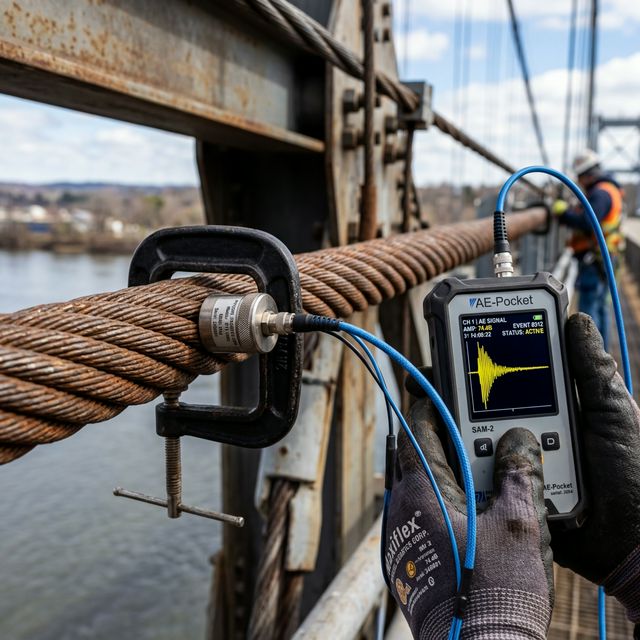
Acoustic Emission Testing (AE)
Method Overview
Continuous passive monitoring of transient elastic waves generated by rapid stress release from growing cracks or leaks.
Core Method Specifications
Target Applications & Governing Standards
2 Scopes ConfiguredMethod Limitations & Operational Boundary Conditions
Critical physics limits, thermal envelopes, blind spots, and ASME Sec V / API procedural boundaries for AE.
Thermal expansion during rapid heat-up generates high-amplitude thermo-acoustic noise that masks active crack signals.
Continuous monitoring method; blind to non-propagating, dormant defects
High-vacuum silicone grease or epoxy adhesive with magnetic hold-down clamps
Passive omnidirectional sensor array: triangulates source location via time-of-flight delta t arrival calculation
- •Passive method: Completely blind to dormant, non-propagating cracks (asset MUST be under active stress, pressurization, or thermal cycle)
- •Yielding in highly ductile metals generates low-amplitude continuous emissions below instrumentation threshold
Fluid turbulent flow, cavitation, and steam throttling valves creating background acoustic noise
Direct volumetric scanning at acoustic source clusters to measure actual crack length and depth
High-precision depth sizing of active growing cracks detected during AE hydrotest
Technique-to-OEM Compatibility Matrix
Verified manufacturers, instrument models, and diagnostic portals supporting AE.
Emerson (AMS CSI)
Global industrial automation enterprise providing AMS condition monitoring, triaxial vibration analyzers, and laser shaft alignment instrumentation for rotating equipment.
Mistras Group
Global enterprise manufacturer and service provider of multi-channel Acoustic Emission (AE) diagnostic instrumentation (Physical Acoustics PAC), automated UT scanners, and asset integrity software.
SKF
Global benchmark multinational for bearing technology, rotating machinery condition monitoring, multi-channel vibration analysis instruments, and lubrication diagnostics.
Vallen Systeme
OEM Manufacturer for AE inspection systems.
PAC Acoustic
OEM Manufacturer for AE inspection systems.