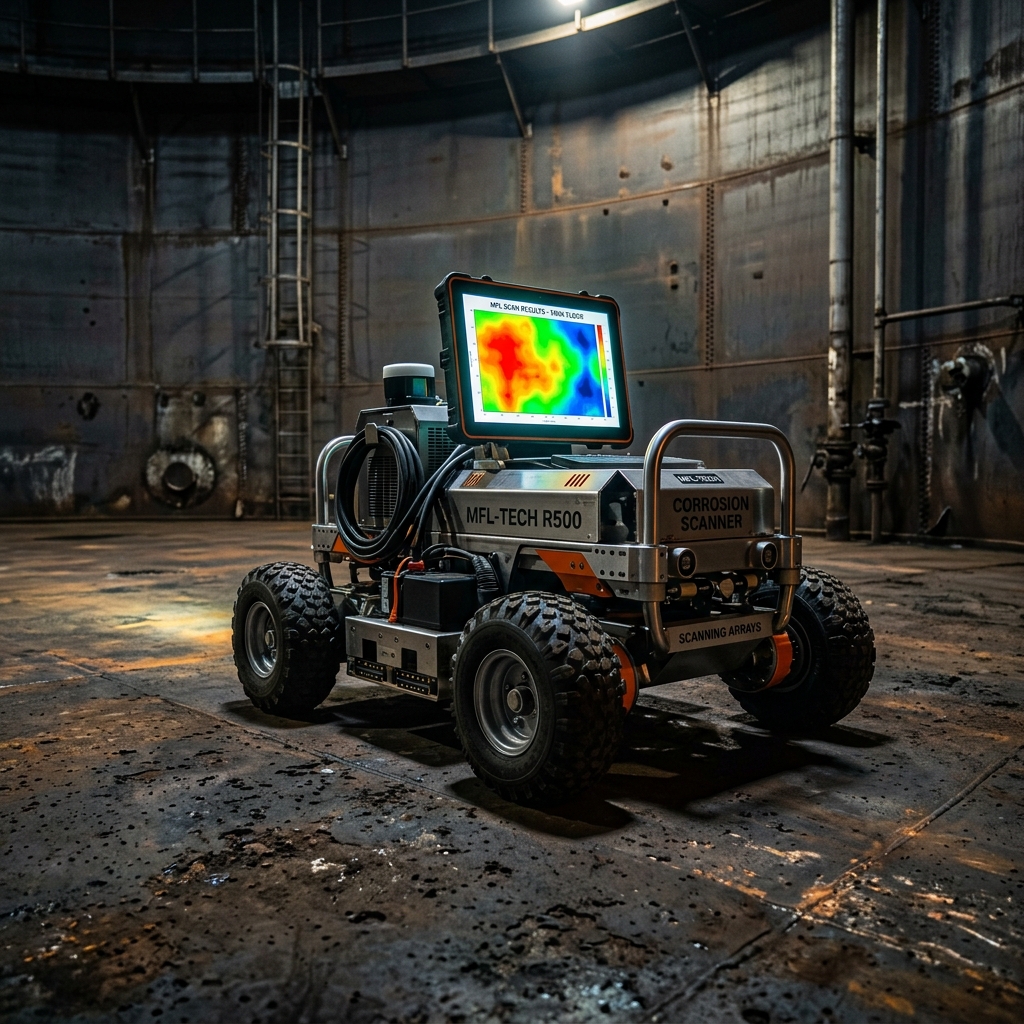
Magnetic Flux Leakage (MFL)
Method Overview
High-speed tank floor and pipeline scanning for the detection of underside corrosion and volumetric wall loss.
Core Method Specifications
Target Applications & Governing Standards
2 Scopes ConfiguredMethod Limitations & Operational Boundary Conditions
Critical physics limits, thermal envelopes, blind spots, and ASME Sec V / API procedural boundaries for MFL.
Hall effect sensors drift with temperature; permanent bridge magnets lose saturation field strength at elevated heat.
Cannot differentiate top-surface from underside (soil-side) corrosion without secondary surface sensors
None (dry electromagnetic flux leakage)
Optimized for volumetric metal loss pits and thinning. Extremely insensitive to narrow longitudinal cracks parallel to magnetic flux path
- •Annular plate lap joint boundary: 75 mm to 100 mm perimeter dead zone along bottom-to-shell fillet weld
- •Tight stress corrosion cracking or fatigue cracks with negligible volume loss
- •Plates thicker than 16 mm where permanent magnets fail to achieve magnetic saturation
Residual weld spatter, backing strips, or underside structural beams concentrating flux lines
Mandatory follow-up: Manual ultrasonic dual-element testing to quantify exact pit depth at MFL alert locations
Inspect annular plate lap welds and the critical bottom-to-shell fillet weld dead zone
Technique-to-OEM Compatibility Matrix
Verified manufacturers, instrument models, and diagnostic portals supporting MFL.
Eddyfi Technologies
Advanced non-destructive testing conglomerate encompassing Eddyfi electromagnetic arrays, Silverwing tank floor scanners, Teletest guided waves, Inuktun robotic crawlers, and M2M phased array instruments.
JIREH Industries
Canadian manufacturer of precision manual and automated ultrasonic scanners, circumferential pipe crawlers, and encoder accessories for weld and corrosion mapping.
ROSEN Group
Global technological leader in in-line pipeline inspection (smart ILI pigs) combining high-resolution Magnetic Flux Leakage (MFL), Ultrasonic Testing (UT), and EMAT for pipeline integrity management.
MFE Enterprises
OEM Manufacturer for MFL inspection systems.