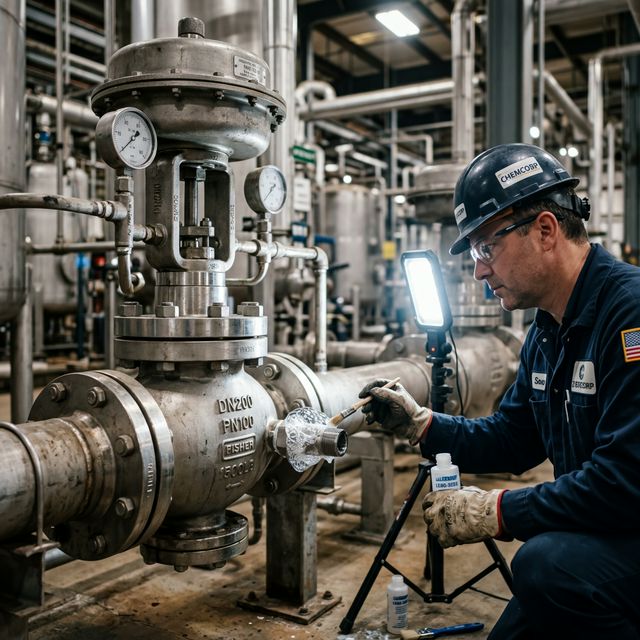
Leak Testing (LT)
Method Overview
Detection and localization of envelope containment breaches using bubble, pressure change, or helium tracer gas sniffers.
Core Method Specifications
Target Applications & Governing Standards
1 Scopes ConfiguredMethod Limitations & Operational Boundary Conditions
Critical physics limits, thermal envelopes, blind spots, and ASME Sec V / API procedural boundaries for LT.
Bubble test solutions freeze below 0°C or dry out prematurely above 50°C, producing zero bubble indications.
Blind to partial wall thinning or defects that do not penetrate 100% of pressure envelope
Formulated high-viscosity bubble solution (ASTM E515) or pure Helium tracer gas (99.99%)
Detects through-wall fluid escape regardless of orientation; vacuum box testing requires flat or cylindrical overlap
- •Blind to partial-thickness defects, deep sub-surface cracks, or thinning that has not fully penetrated the wall
- •Clogged leak paths: Water, grease, or corrosion products trapped inside crack capillaries block tracer gas passage
Helium background saturation in enclosed rooms creating elevated ambient reading on sniffer detectors
Localize fine crack opening path on accessible outer surfaces
Measure remaining wall thickness surrounding verified through-wall pinholes
Technique-to-OEM Compatibility Matrix
Verified manufacturers, instrument models, and diagnostic portals supporting LT.
FLIR Systems (Teledyne FLIR)
World benchmark manufacturer of radiometric thermal imaging cameras, optical gas imaging (OGI) leak cameras, acoustic acoustic imagers, and drone payloads under Teledyne Technologies.
Inficon
Global instrumentation manufacturer specializing in high-sensitivity helium mass spectrometer leak detectors, hydrogen forming gas detectors, and vacuum gauge analyzers.
Percepto
Autonomous Drone-in-a-Box (Air Max & Air Mobile) and AIM software platform for continuous automated visual, thermal, and optical gas inspection of refineries, mines, and utilities.
Pfeiffer Vacuum
OEM Manufacturer for LT inspection systems.
Leybold
OEM Manufacturer for LT inspection systems.
Agilent
OEM Manufacturer for LT inspection systems.