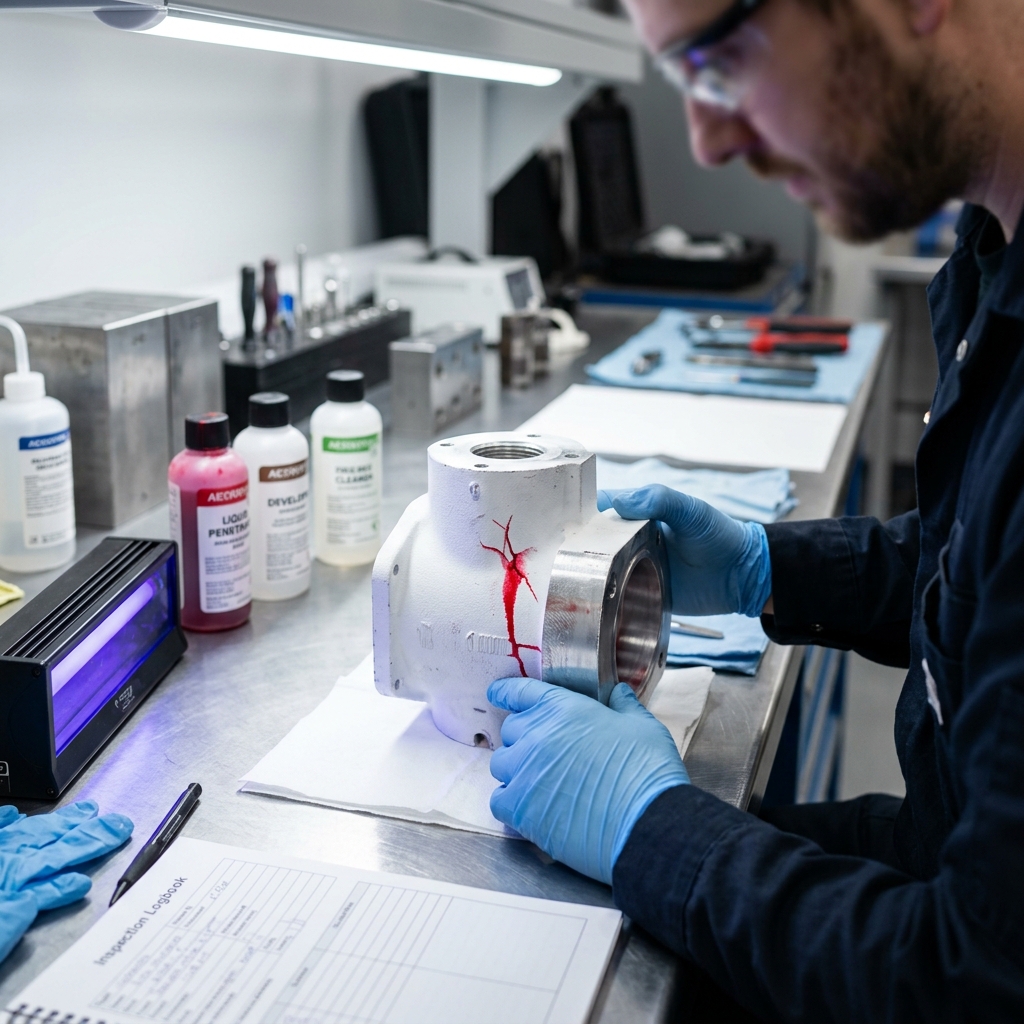
Liquid Penetrant Testing (PT)
Method Overview
Detection of surface-breaking defects in non-porous materials through capillary action of visible or fluorescent dye penetrants.
Core Method Specifications
Target Applications & Governing Standards
2 Scopes ConfiguredMethod Limitations & Operational Boundary Conditions
Critical physics limits, thermal envelopes, blind spots, and ASME Sec V / API procedural boundaries for PT.
Below 5°C, penetrant viscosity rises exponentially, severely hindering capillary draw. Above 52°C, standard dye carriers boil or evaporate prematurely.
Completely blind to sub-surface defects (even 0.01 mm below surface)
Solvent-removable or water-washable penetrant + non-aqueous wet developer
Completely omnidirectional; detects linear, branched, and rounded openings of any orientation
- •Sub-surface or internal discontinuities with no direct opening to the inspection surface
- •Surface cracks contaminated with grease, carbonized oil, paint, water, or mechanical smeared metal
- •Porous materials (sintered metals, unglazed ceramics) that absorb penetrant uncontrollably
Incomplete pre-wash / background wash leaving residual penetrant in weld toe valleys and grind marks
For ferromagnetic steels with lightly coated surfaces or where solvent stripping is restricted
Volumetric depth sizing of cracks confirmed at the surface by penetrant bleed
Technique-to-OEM Compatibility Matrix
Verified manufacturers, instrument models, and diagnostic portals supporting PT.
Magnaflux
Industry benchmark division of ITW for fluorescent liquid penetrant inspection (FPI), magnetic particle inspection (MPI) consumables, UV-A inspection lamps, and wet horizontal test benches.
Sherwin Incorporated
OEM Manufacturer for PT inspection systems.
Met-L-Chek
OEM Manufacturer for PT inspection systems.
Chemetall
OEM Manufacturer for PT inspection systems.