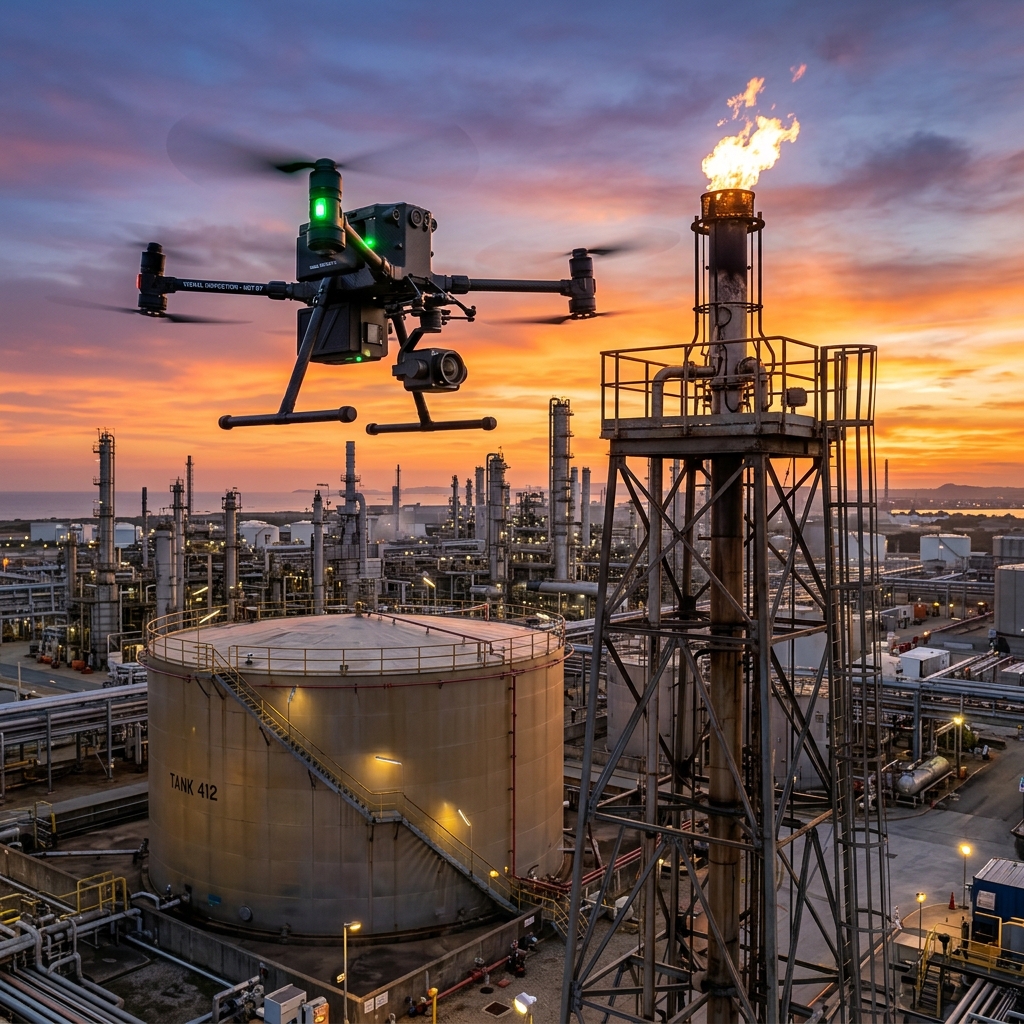
Drone Visual Testing (DVT)
Method Overview
Aerial and confined-space visual inspection using UAV platforms equipped with HD/4K cameras, LiDAR, and thermal sensors. Used for elevated, hazardous, or inaccessible structures such as flare stacks, towers, bridges, and offshore jackets without scaffolding.
Core Method Specifications
Target Applications & Governing Standards
1 Scopes ConfiguredDrone-Assisted & Confined Space Aerial Visual Inspection (DVT)
Drone Visual Testing (DVT) combines unmanned aerial vehicles (UAVs), high-resolution optical zoom sensors, thermal thermography, and collision-tolerant protective cages to perform high-elevation, hazardous, or internal confined-space inspections without human exposure or costly scaffolding setup.
Eliminates rope access and scaffolding for flare stacks, boiler internals, storage sphere domes, and elevated piperacks.
Integrates 4K optical zoom cameras, FLIR thermal imaging, Oblique LiDAR mapping, and distance-to-surface laser rangefinders.
Internal RVI drones (e.g. Flyability Elios series) feature protective carbon fiber cages for bouncing off obstacle walls safely inside boilers and pressure vessels.
Primary Industrial Target Assets
Method Limitations & Operational Boundary Conditions
Critical physics limits, thermal envelopes, blind spots, and ASME Sec V / API procedural boundaries for DVT.
Lithium polymer (LiPo) batteries experience rapid voltage sag in sub-zero temperatures and thermal runaway risks above 50°C.
Camera minimum macro focus distance typically 0.2 m (8 in)
None
Omnidirectional multi-axis gimbal with 180° upward tilt (+90° to -90°) allows inspection of tank roofs and underside bridge decks
- •Sub-surface defects: Completely blind to internal cracks, wall thinning, and lack of fusion (strictly visual/thermal surface inspection)
- •Airborne dust, smoke, steam, or heavy rain reflecting LiDAR and LED illumination back into camera lens
- •Atmospheres exceeding explosive LEL thresholds (requires OSHA 1910.146 4-Gas sniffer permit)
Optical parallax distortion and lens barrel distortion when measuring crack widths from oblique camera angles
Follow up visual corrosion findings with physical ultrasonic thickness gauging via crawler or rope access
Rigid videoscope inspection for tight internal passages where drone cage cannot enter (< 400 mm)
Technique-to-OEM Compatibility Matrix
Verified manufacturers, instrument models, and diagnostic portals supporting DVT.
FLIR Systems (Teledyne FLIR)
World benchmark manufacturer of radiometric thermal imaging cameras, optical gas imaging (OGI) leak cameras, acoustic acoustic imagers, and drone payloads under Teledyne Technologies.
Flyability
Swiss pioneer of collision-resilient confined-space inspection drones (Elios series) with protective cage and multi-sensor payloads (UT thickness gauge, LiDAR 3D, and thermal) for tanks, boilers, and chimneystacks.
Skydio
Autonomous AI-powered inspection drones (Skydio X10/X2) equipped with 360° computer-vision obstacle avoidance, thermal cameras, and automated 3D scan mapping for critical industrial assets.
Percepto
Autonomous Drone-in-a-Box (Air Max & Air Mobile) and AIM software platform for continuous automated visual, thermal, and optical gas inspection of refineries, mines, and utilities.
Easy Aerial
Tethered and autonomous free-flight drone monitoring systems designed for long-endurance visual testing (DVT) and thermal perimeter monitoring of industrial energy assets.