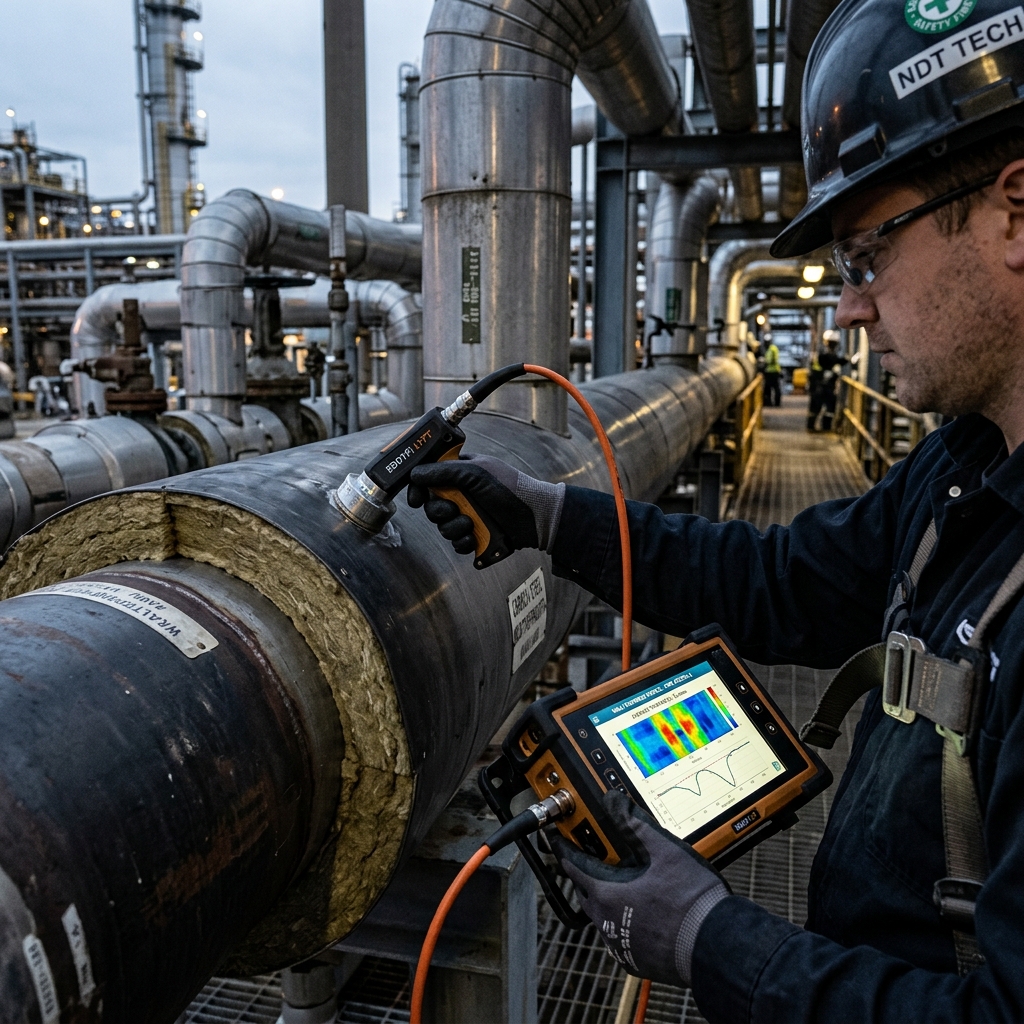
Pulsed Eddy Current (PEC)
Method Overview
Measurement of wall thickness through insulation, fireproofing, or coatings to screen for Corrosion Under Insulation (CUI).
Core Method Specifications
Target Applications & Governing Standards
2 Scopes ConfiguredMethod Limitations & Operational Boundary Conditions
Critical physics limits, thermal envelopes, blind spots, and ASME Sec V / API procedural boundaries for PEC.
Component metal temperature must be entered into software algorithm to calculate proper electrical conductivity curve.
Measures average wall volume within probe electromagnetic footprint; cannot differentiate OD from ID loss
None
Measures volume loss within magnetic footprint. Insensitive to crack orientation
- •Isolated small pinhole pitting: Discontinuities with diameter smaller than probe footprint diameter are averaged out and severely undersized
- •Cannot differentiate whether wall loss is external (CUI) or internal process-side erosion
- •Severe signal distortion near galvanized steel insulation cladding or chicken wire mesh reinforcement
Varying thickness of weather jacketing lap bands or steel strapping mimicking localized metal loss
Targeted insulation plug removal and high-precision UT thickness gauging at locations flagged by PEC
Profile digital radiography to visually examine pipe wall silhouette through insulation
Technique-to-OEM Compatibility Matrix
Verified manufacturers, instrument models, and diagnostic portals supporting PEC.
Eddyfi Technologies
Advanced non-destructive testing conglomerate encompassing Eddyfi electromagnetic arrays, Silverwing tank floor scanners, Teletest guided waves, Inuktun robotic crawlers, and M2M phased array instruments.
Ether NDE
British designer and manufacturer of high-performance eddy current (ET) flaw detectors, pencil probes, and custom aerospace rotating scanner probes.
Maxwell NDT
OEM Manufacturer for PEC inspection systems.
Kromek
OEM Manufacturer for PEC inspection systems.