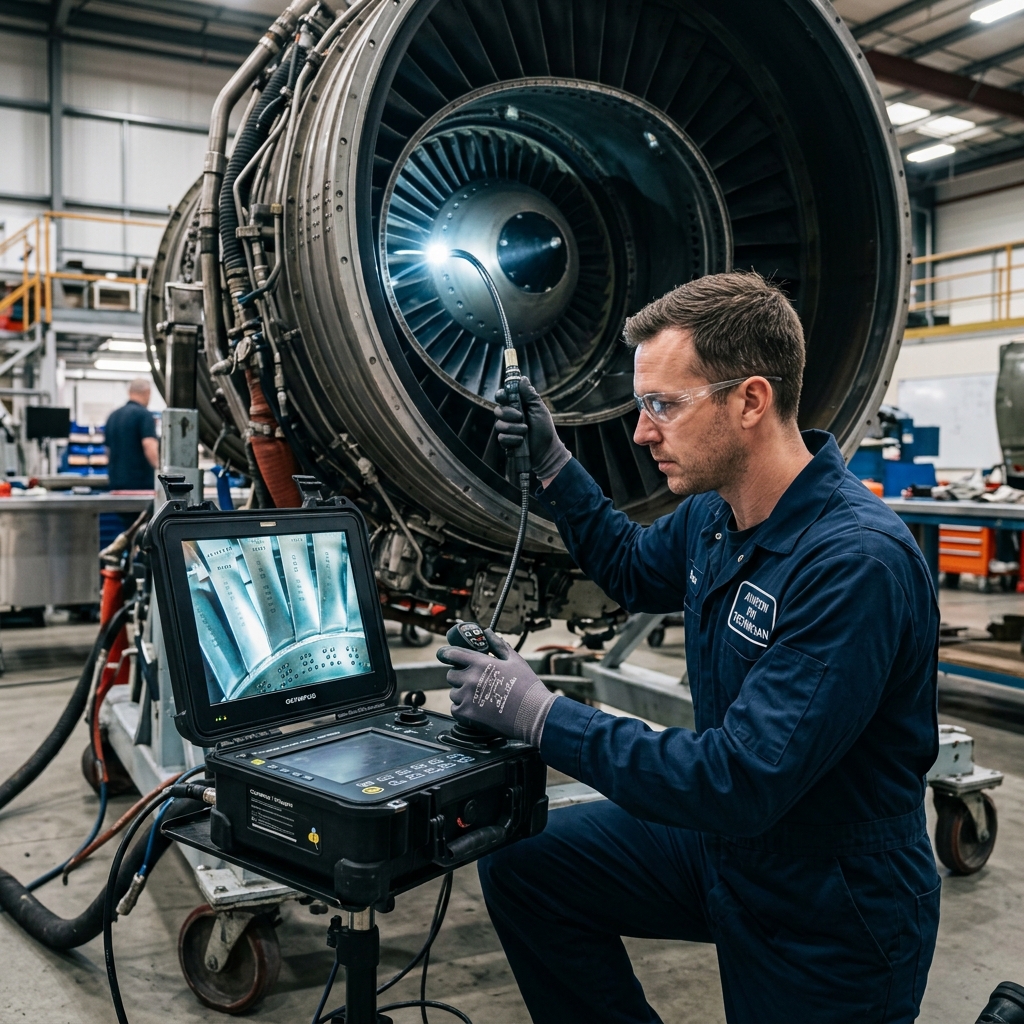
Remote Visual Inspection (RVI)
Method Overview
High-definition internal visual assessment of boilers, turbines, and pipes using robotic crawlers and videoborescopes.
Core Method Specifications
Target Applications & Governing Standards
2 Scopes ConfiguredMethod Limitations & Operational Boundary Conditions
Critical physics limits, thermal envelopes, blind spots, and ASME Sec V / API procedural boundaries for RVI.
CCD/CMOS video camera chips produce severe color noise and thermal pixel burnout above 60°C.
Minimum optical focal distance is 3 mm to 5 mm from lens
None
Requires direct optical line of sight; 4-way probe tip articulation (up to 160° bend) overcomes internal pipe elbows
- •Internal subsurface cracks (zero visibility beneath surface oxide layers)
- •Lens fogging, oil contamination, or condensation completely blinding the optical view
Lighting glare and specular LED reflection hot spots mimicking cracks or through-wall pinholes
Measure quantitative remaining wall thickness inside tubes where RVI only sees surface discoloration
Electromagnetic crack detection under internal deposits and scale
Technique-to-OEM Compatibility Matrix
Verified manufacturers, instrument models, and diagnostic portals supporting RVI.
Evident Scientific
Global leader in advanced optical, ultrasonic, and radiographic inspection technologies (formerly Olympus Scientific Solutions).
Waygate Technologies
Global industrial inspection conglomerate under Baker Hughes, encompassing Krautkrämer ultrasonic, Seifert radiography, Everest borescopes, and phoenix|x-ray computed tomography.
Flyability
Swiss pioneer of collision-resilient confined-space inspection drones (Elios series) with protective cage and multi-sensor payloads (UT thickness gauge, LiDAR 3D, and thermal) for tanks, boilers, and chimneystacks.
Mitcorp
Specialist global designer and manufacturer of high-definition articulating videoscopes, borescopes, and inspection cameras for aerospace, automotive, and power generation.
USA Borescopes
Premier American manufacturer and authorized distributor of articulating videoborescopes, fiberscopes, aviation turbine inspection cameras, and pipe push cameras.
Eddyfi Technologies
OEM Manufacturer for RVI inspection systems.