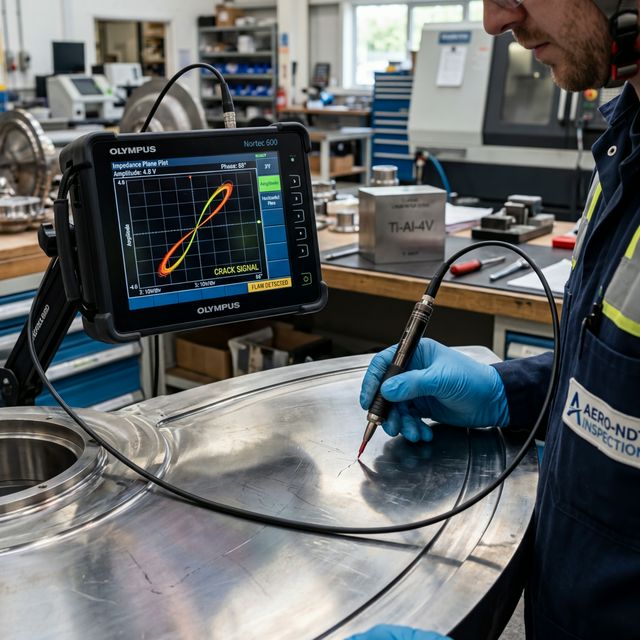
Eddy Current Testing (ET)
Method Overview
Near-surface flaw detection and material sorting using electromagnetic induction for high-speed alloy assessment.
Core Method Specifications
Target Applications & Governing Standards
2 Scopes ConfiguredMethod Limitations & Operational Boundary Conditions
Critical physics limits, thermal envelopes, blind spots, and ASME Sec V / API procedural boundaries for ET.
Electrical conductivity of metals varies with temperature (-0.4%/°C for copper). Phase angle calibration drifts rapidly during thermal swings.
Zero dead zone at entry surface; detection drops exponentially with depth
None (completely dry, non-contact electromagnetic induction)
Defects must disrupt circular eddy current flow. Flaws parallel to current paths (longitudinal cracks with bobbin probe) produce minimal impedance change
- •Ferromagnetic Carbon Steel Tubing: Standard ET is rendered blind by high magnetic permeability and skin depth suppression (must use RFET, NFT, or MFL instead)
- •Outer-diameter defects hidden behind external support baffles (baffle signal masks tube fretting wear)
- •Tight defects deeper than 3 standard depths of penetration (3δ)
Liftoff variations caused by probe wobble or tube denting misinterpreted as wall loss
Ultrasonic rotary immersion testing to verify wall loss and measure absolute thickness behind baffles
Internal borescope inspection to visually verify pitting versus scale deposit build-up
Technique-to-OEM Compatibility Matrix
Verified manufacturers, instrument models, and diagnostic portals supporting ET.
Evident Scientific
Global leader in advanced optical, ultrasonic, and radiographic inspection technologies (formerly Olympus Scientific Solutions).
Waygate Technologies
Global industrial inspection conglomerate under Baker Hughes, encompassing Krautkrämer ultrasonic, Seifert radiography, Everest borescopes, and phoenix|x-ray computed tomography.
Eddyfi Technologies
Advanced non-destructive testing conglomerate encompassing Eddyfi electromagnetic arrays, Silverwing tank floor scanners, Teletest guided waves, Inuktun robotic crawlers, and M2M phased array instruments.
Zetec
Advanced eddy current and ultrasonic NDT technology subsidiary of Eddyfi/Roper for nuclear power generation, aerospace, and balance-of-plant tube inspections.
TSC Subsea
Specialist offshore manufacturer of Alternating Current Field Measurement (ACFM) crack detection instruments and ROV-deployable scanners for subsea jackets and risers.
Mistras Group
Global enterprise manufacturer and service provider of multi-channel Acoustic Emission (AE) diagnostic instrumentation (Physical Acoustics PAC), automated UT scanners, and asset integrity software.
Russell NDE Systems
Canadian pioneer of Remote Field Electromagnetic Technique (RFET) and Near Field Testing (NFT) instrumentation and in-line crawlers for boiler and condenser tubes.
Ether NDE
British designer and manufacturer of high-performance eddy current (ET) flaw detectors, pencil probes, and custom aerospace rotating scanner probes.
Electronic & Engineering Co. (EECI)
Renowned Indian manufacturer of custom ultrasonic probes, phased array wedges, automated ultrasonic inspection systems, and magnetic particle test benches.
Kardens NDT Metrology
German specialist precision EDM notch reference calibration blocks, ASME / ISO calibration standards, and custom test pieces.
Rohmann
OEM Manufacturer for ET inspection systems.