Robotic & Automated NDT Systems (Robotic NDT)
Method Overview
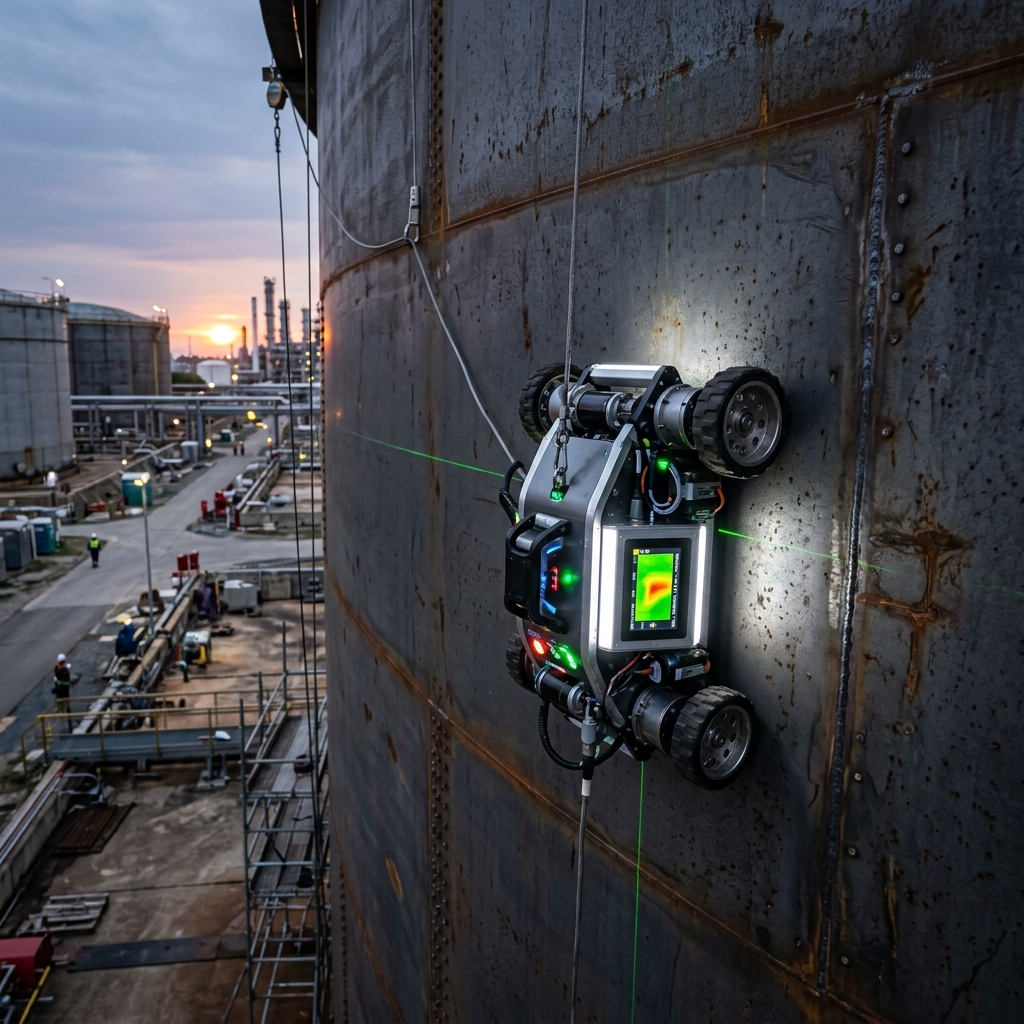
Automated magnetic crawlers, pipe inspection crawlers, and robotic manipulators for hazardous and un-manned in-service inspections.
Core Method Specifications
Target Applications & Governing Standards
1 Scopes ConfiguredMethod Limitations & Operational Boundary Conditions
Critical physics limits, thermal envelopes, blind spots, and ASME Sec V / API procedural boundaries for Robotic NDT.
Permanent rare-earth magnetic drive wheels undergo irreversible magnetic loss above 80°C unless cooled.
Governed by the mounted payload (typically PAUT, EMAT, or MFL sensor specifications)
Continuous pressurized couplant pumping system delivered through umbilical tether
Magnetic wheels hold crawler in any orientation (vertical, upside-down ceiling, overhead tank roofs)
- •Non-ferromagnetic assets (stainless steel tanks, aluminum vessels): Standard magnetic crawlers cannot adhere or climb without vacuum suction tracks
- •Sharp nozzle corners and obstacle dead zones within 150 mm of internal structural stiffeners
Crawler wheel slippage causing encoder position drift and distorted C-scan spatial mapping coordinates
Drone visual testing for high-elevation internal visual reconnaissance prior to crawler launch
Manual ultrasonic verification on areas obstructed by structural internal stiffeners
Technique-to-OEM Compatibility Matrix
Verified manufacturers, instrument models, and diagnostic portals supporting Robotic NDT.
Waygate Technologies
Global industrial inspection conglomerate under Baker Hughes, encompassing Krautkrämer ultrasonic, Seifert radiography, Everest borescopes, and phoenix|x-ray computed tomography.
Eddyfi Technologies
Advanced non-destructive testing conglomerate encompassing Eddyfi electromagnetic arrays, Silverwing tank floor scanners, Teletest guided waves, Inuktun robotic crawlers, and M2M phased array instruments.
TSC Subsea
Specialist offshore manufacturer of Alternating Current Field Measurement (ACFM) crack detection instruments and ROV-deployable scanners for subsea jackets and risers.
Gecko Robotics
Pioneer of wall-climbing magnetic NDT crawlers (TOKA series) that capture millions of ultrasonic thickness readings across boilers, tanks, and pressure vessels for predictive digital twin analysis.
JIREH Industries
Canadian manufacturer of precision manual and automated ultrasonic scanners, circumferential pipe crawlers, and encoder accessories for weld and corrosion mapping.
Phoenix ISL
UK boutique designer of specialized ultrasonic transducers, custom PAUT phased array probes, and automated robotic scanners for nuclear and aerospace.
ScanTech Instruments
Boutique manufacturer of specialized subsea automated UT crawlers, bespoke magnetic scanners, and high-temp corrosion inspection heads.