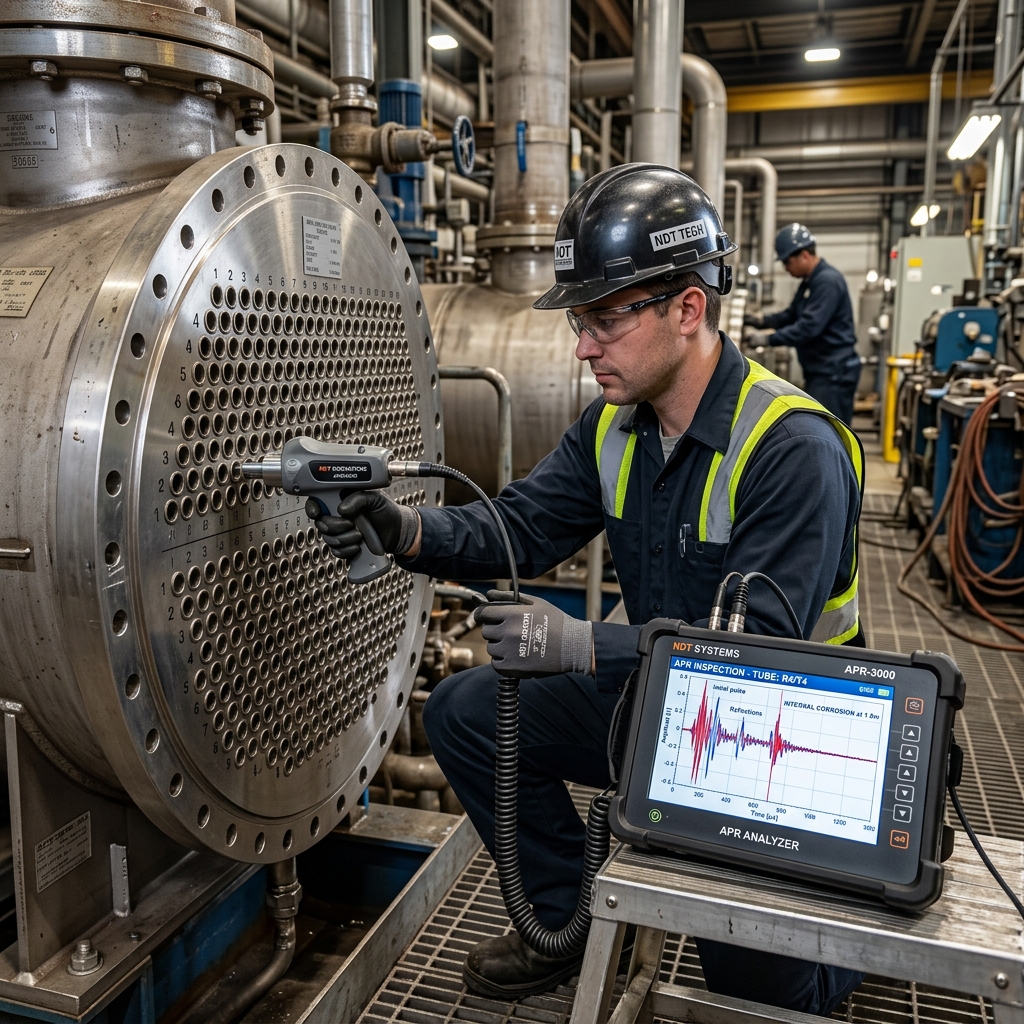
Acoustic Pulse Reflectometry (APR)
Method Overview
Ultra-fast acoustic wave inspection method for non-destructively screening tubes of any material (ferrous, non-ferrous, finned, or graphite) up to 4 inches in diameter for leaks, blockages, erosion, and pitting in seconds per tube.
Core Method Specifications
Target Applications & Governing Standards
2 Scopes ConfiguredMethod Limitations & Operational Boundary Conditions
Critical physics limits, thermal envelopes, blind spots, and ASME Sec V / API procedural boundaries for APR.
Speed of sound in air varies with tube temperature; tube air temperature must be entered before test.
First 0.3 m (12 in) immediately adjacent to tube sheet face masked by initial acoustic excitation pulse
None (air-coupled acoustic pulse injection via nosepiece)
Acoustic pulse travels down internal bore; sensitive to through-wall holes, wall thinning, and blockages regardless of clock orientation
- •First 300 mm (12 in) of tube entry: Flaws located within the tube sheet expansion zone are masked by the acoustic injection blast
- •Water pools inside tube: Water puddles reflect acoustic energy like a blockage or hole, creating false indications
Improper nosepiece seal against tube face allowing ambient noise to enter pulse stream
Ultrasonic rotary immersion scanning on suspect tubes to measure exact remaining wall thickness
Inspect the tube sheet expansion roll transition masked by APR near-field blast
Technique-to-OEM Compatibility Matrix
Verified manufacturers, instrument models, and diagnostic portals supporting APR.
TALCYON
Pioneer of Acoustic Pulse Reflectometry (APR / APRIS) technology for ultra-fast, non-invasive inspection of heat exchanger tubes, boilers, and fin fans within seconds.
SWIS Ltd (MachOne)
OEM Manufacturer for APR inspection systems.