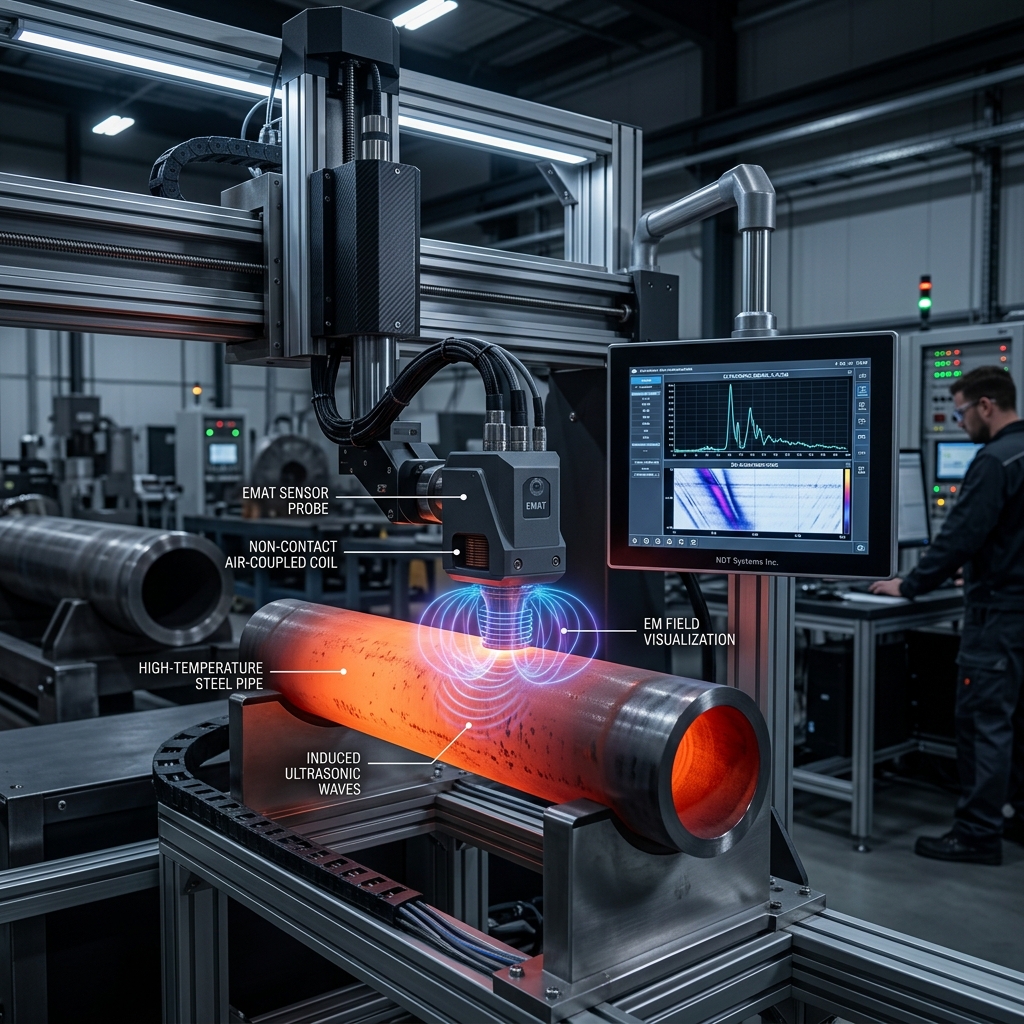
Electro Magnetic Acoustic Transducer (EMAT)
Method Overview
Non-contact electromagnetic ultrasonic testing for high-temperature corrosion mapping, boiler tube inspection, and dry testing.
Core Method Specifications
Target Applications & Governing Standards
1 Scopes ConfiguredMethod Limitations & Operational Boundary Conditions
Critical physics limits, thermal envelopes, blind spots, and ASME Sec V / API procedural boundaries for EMAT.
Curie point limit (770°C for steel); Lorenz force generation drops as component enters austenitic transition.
Minimal ringdown dead zone; can generate shear horizontal (SH) waves right at the contact face
COMPLETELY DRY (Zero liquid couplant required; sound is generated directly inside the metal via Lorentz force and magnetostriction)
Generates pure Shear Horizontal (SH) waves that propagate without mode conversion, ideal for clad materials
- •Non-conductive, non-magnetic materials: Cannot inspect plastics, ceramics, or glass (requires electrical conductivity or ferromagnetic response)
- •Lower signal-to-noise ratio (SNR) compared to conventional piezo transducers requires high averaging filters
Liftoff variations causing sudden amplitude drop on heavily encrusted boiler tubes
Conventional piezoelectric UT for low-temperature baseline calibration on smooth polished spots
Screen for corrosion under thick insulation exceeding EMAT lift-off limits (> 3 mm)
Technique-to-OEM Compatibility Matrix
Verified manufacturers, instrument models, and diagnostic portals supporting EMAT.
Eddyfi Technologies
Advanced non-destructive testing conglomerate encompassing Eddyfi electromagnetic arrays, Silverwing tank floor scanners, Teletest guided waves, Inuktun robotic crawlers, and M2M phased array instruments.
Innerspec Technologies
World leader in Electro Magnetic Acoustic Transducer (EMAT) technology and dry-coupled ultrasonic testing (DCUT) for high-temperature and couplant-free inspection.
ROSEN Group
Global technological leader in in-line pipeline inspection (smart ILI pigs) combining high-resolution Magnetic Flux Leakage (MFL), Ultrasonic Testing (UT), and EMAT for pipeline integrity management.
Sonatest
OEM Manufacturer for EMAT inspection systems.