Ground Penetrating Radar (GPR)
Method Overview
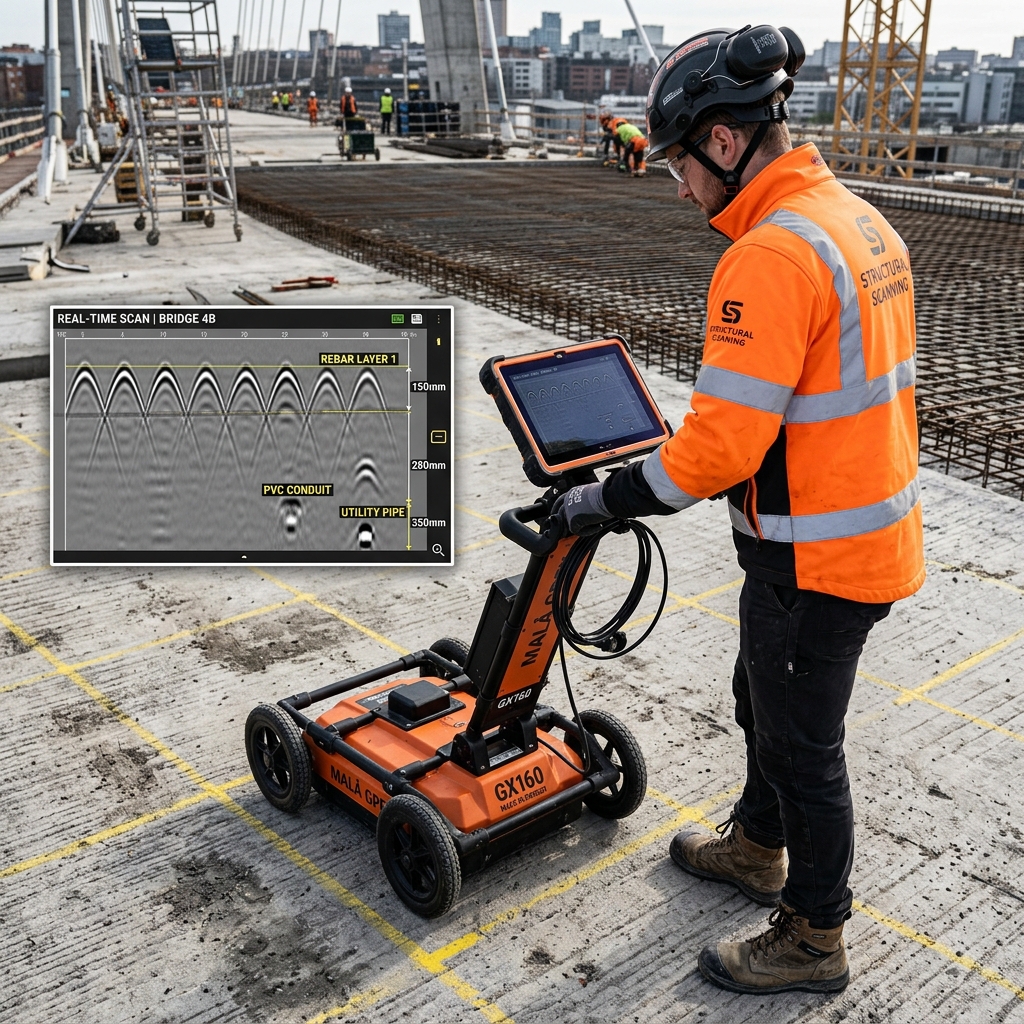
Subsurface imaging method projecting electromagnetic radar pulses to detect rebar, conduits, and voids in concrete or soil structures.
Core Method Specifications
Target Applications & Governing Standards
3 Scopes ConfiguredMethod Limitations & Operational Boundary Conditions
Critical physics limits, thermal envelopes, blind spots, and ASME Sec V / API procedural boundaries for GPR.
Frozen soil or subgrade ice significantly alters dielectric permittivity, speeding up radar waves.
Direct antenna coupling wave obscures the first 20 mm to 50 mm (0.8 to 2.0 in) beneath antenna face
None (air-launched or direct ground-coupled electromagnetic pulses)
Antenna polarization MUST cross linear targets (rebar, pipes) at 90° angle for optimum hyperbolic reflection profiles
- •Wet conductive clay soils, saline subgrade, and fresh un-cured concrete (< 28 days old) completely absorb and dissipate radar pulses
- •Closely spaced dense rebar mats (spacing < 50 mm) create a Faraday cage shield, blocking radar from seeing conduits below
Ghost hyperbolic reflections from overhead steel beams, metal fences, or cart wheels (air wave reflections)
Ultrasonic pulse velocity (UPV) or ultrasonic shear wave tomography (MIRA) to verify concrete voids
Electromagnetic rebar cover meter (pachometer) to verify shallow rebar depth and diameter
Technique-to-OEM Compatibility Matrix
Verified manufacturers, instrument models, and diagnostic portals supporting GPR.
Sensors & Software (Radiodetection)
Canadian designer of Ground Penetrating Radar (GPR) systems for concrete structural evaluation, utility detection, and geological scanning under SPX Technologies.
GSSI (Geophysical Survey Systems)
Global pioneer and market leader in Ground Penetrating Radar (GPR) systems for concrete rebar imaging, bridge deck evaluation, utility locating, and geotechnical surveys.
MALÅ GPR (Guideline Geo)
Swedish manufacturer under Guideline Geo providing HDR Ground Penetrating Radar systems for infrastructure integrity, pavement analysis, and utility mapping.
IDS GeoRadar (Hexagon)
Hexagon subsidiary manufacturing multi-channel array GPR and slope stability radar systems for geotechnical monitoring and underground utility 3D modeling.
Sensors & Software
OEM Manufacturer for GPR inspection systems.
GSSI
OEM Manufacturer for GPR inspection systems.
MALA GPR
OEM Manufacturer for GPR inspection systems.
IDS GeoRadar
OEM Manufacturer for GPR inspection systems.